

Corporate Liability Law: Supreme Court Rules on Prosecuting Companies Without Naming Directors as Accused
India’s corporate criminal law has entered a significant new phase after the Supreme Court’s 2026 Sanofi India judgment. This article explains corporate attribution, director liability, statutory remedies, and relevant Chennai forums.
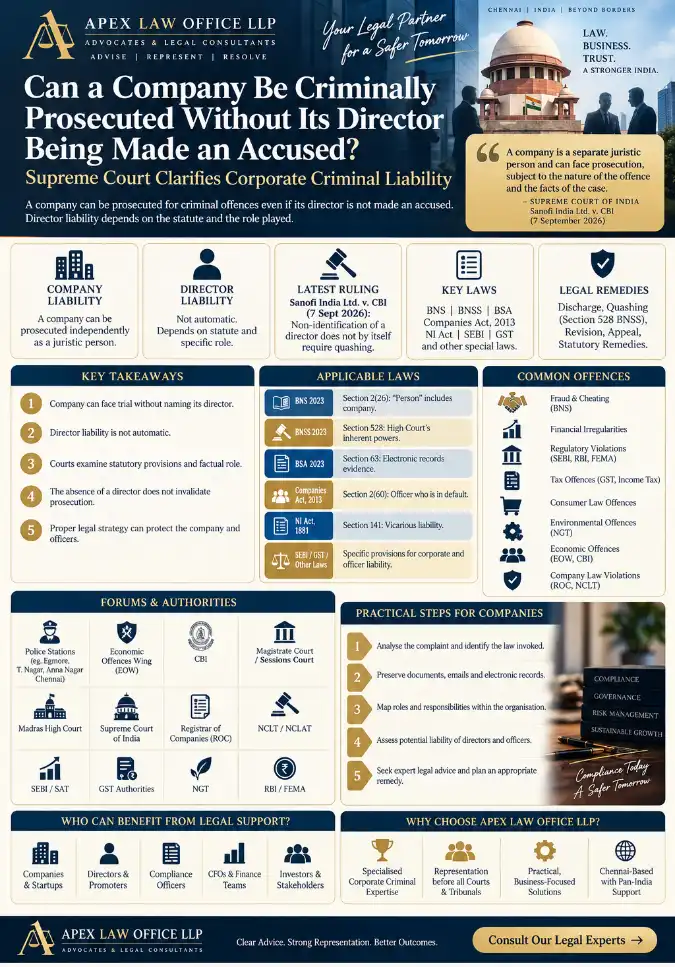
⚖️ 2026 Supreme Court Ruling
Sanofi India Ltd. v. CBI
A company may face prosecution without prior identification or arraignment of the natural person, subject to legally sustainable corporate attribution.
🏢 Corporate Entity
A company has separate legal personality and may face criminal prosecution where the offence permits corporate liability.
👤 Director
Directorial status alone does not create universal criminal liability. The statute and facts determine individual exposure.
🔍 Attribution
Corporate mens rea requires a legally recognised connection between human conduct and the corporate entity.
📜 Current Laws
BNS • BNSS • BSA • Companies Act • NI Act • GST laws • SEBI laws • FEMA.
🏛️ Remedies
Discharge • Bail • Revision • Statutory Appeal • Section 528 BNSS • Regulatory Remedies.
📍 Chennai Legal Support
Madras High Court • Magistrate Courts • Sessions Courts • NCLT • NCLAT • ROC Chennai • EOW • SEBI • GST Authorities.
Corporate Criminal Liability After the 2026 Supreme Court Ruling
Corporate criminal liability has gained renewed importance after the Supreme Court judgment in Sanofi India Ltd. v. Central Bureau of Investigation. The judgment was delivered on 7 September 2026 in Criminal Appeal No. 4250 of 2026. The Court considered prosecution against a company where no company employee had been arraigned. Importantly, the Court rejected a blanket rule requiring prior identification of a natural person. Corporate mens rea can arise through attribution under established legal principles. Therefore, a company may face prosecution even when the individual actor remains unidentified. However, the prosecution must still disclose a legally sustainable case against the corporate entity. The judgment separates corporate liability from automatic director liability. Consequently, directors should examine their personal exposure under the specific statute. Companies should also examine their internal decision-making structures and delegation records. This distinction matters for corporate fraud, procurement offences, regulatory violations, and other economic offences. Accordingly, businesses should treat the ruling as an attribution decision, not as unrestricted corporate criminal liability.
What the Supreme Court Actually Decided in Sanofi India
The Supreme Court examined whether proceedings against Sanofi India Limited required identification and arraignment of an individual officer. The company had been prosecuted alongside allegations involving procurement irregularities at BARC. No Sanofi employee had been arraigned as an accused in the charge-sheet. The company challenged continuation of the criminal proceedings on that basis. The Supreme Court dismissed the appeal and examined corporate attribution in considerable detail. It held that non-identification alone does not automatically defeat prosecution against a corporation. Likewise, non-arraignment alone does not create an absolute bar against corporate prosecution. The Court developed an attribution framework for corporate mens rea under Indian criminal law. That framework considers company law, delegated authority, and the purpose of the relevant offence. Therefore, courts must examine the allegations rather than apply an automatic procedural formula. This approach preserves corporate accountability while keeping individual liability legally distinct. For directors, the ruling does not create automatic criminal exposure. Instead, it requires careful analysis of the company’s conduct and each person’s statutory position.
Why Corporate Attribution Matters in Criminal Law
A corporation has no physical body capable of personally performing an act. Yet modern criminal statutes can impose liability upon corporate entities. The legal system therefore requires a method for attributing conduct and mental states to companies. Corporate attribution connects human conduct with the separate legal personality of the company. The Supreme Court’s 2026 judgment places attribution at the centre of this inquiry. First, the court considers the company’s constitutional arrangements and governing rules. Next, the court considers express or implied delegation of relevant authority. Finally, a special attribution rule may arise from the purpose of the offence. Consequently, corporate criminal liability does not depend upon naming every employee. Instead, the allegations must support attribution through a legally recognised route. This principle affects corporate fraud, cheating, corruption-related allegations, and regulatory offences. It also matters during investigations by the Central Bureau of Investigation and Economic Offences Wing. Therefore, companies should preserve documents showing authority, delegation, approvals, and decision-making processes.
Company Liability and Director Liability Are Separate Questions
Company prosecution and director prosecution involve separate legal inquiries. A company possesses a legal identity distinct from its directors and shareholders. Therefore, prosecution against the company does not automatically prosecute every person associated with it. Individual liability usually requires a statutory or factual foundation connecting the person with the offence. Some special statutes expressly create vicarious liability for specified officers. Other offences require proof of personal participation, knowledge, consent, connivance, or another recognised basis. Accordingly, a complaint should not treat every director as interchangeable. Courts examine the allegations, statutory provisions, and available material concerning each accused person. The Companies Act also identifies circumstances involving an officer who is in default. Section 2(60) can therefore become relevant in statutory compliance prosecutions. Meanwhile, Section 149(12) provides specific protection for qualifying independent directors and non-executive directors. However, that protection operates within statutory conditions and cannot be treated as absolute immunity. Consequently, corporate governance records can become important evidence during criminal proceedings.
The BNS Definition of Person and Corporate Prosecution
The Bharatiya Nyaya Sanhita, 2023 contains an important definition for corporate criminal proceedings. Section 2(26) states that person includes a company, association, or body of persons. The provision therefore recognises corporate entities within the statutory concept of person. However, the definition alone does not make every offence applicable to every company. The ingredients of the particular offence must still be satisfied. Courts must therefore read the definition together with the substantive offence provision. The BNS applies to offences falling within its statutory framework from its commencement. Transitional provisions also matter when proceedings concern conduct occurring under the previous criminal codes. Therefore, lawyers must determine the relevant date, offence, and applicable savings provision. Companies should avoid treating BNS provisions as isolated from special statutes. Corporate offences may also involve the Companies Act, GST legislation, SEBI laws, FEMA, or other enactments. Consequently, proper statutory mapping should precede any criminal defence strategy. This approach reduces confusion between general criminal law and sector-specific regulatory liability.
Mens Rea and the Corporate Mind
Mens rea presents a distinctive issue in corporate criminal law because companies operate through natural persons. The Supreme Court’s Sanofi India judgment addresses this issue through attribution. A corporation may possess a legally attributable mental state through the conduct of relevant human agents. The court must therefore identify a legally recognised connection between the person’s conduct and corporate responsibility. The inquiry does not require an artificial assumption that every employee represents the company’s mind. Instead, attribution depends upon authority, delegation, corporate rules, and the purpose of the offence. Consequently, junior employee conduct may require different analysis from board-level decision-making. Internal emails, approvals, board minutes, compliance reports, and transaction records can become significant evidence. Furthermore, investigators may examine reporting lines and delegated authority. A company should therefore preserve records explaining who approved a transaction and why. Such documentation can clarify whether alleged conduct falls within corporate decision-making structures. Ultimately, mens rea analysis requires factual examination rather than a simple label based upon corporate status.
The Three-Stage Attribution Framework
Corporate attribution follows a structured approach under the Supreme Court’s 2026 reasoning. First, the court examines the company’s constitutional documents and rules governing corporate authority. Next, the court considers express or implied delegation of the power involved in the alleged conduct. Finally, the court considers a special attribution rule based upon the purpose of the statutory provision. This framework helps courts determine whose acts and mental state may represent the corporation. Importantly, the stages do not mean that every employee automatically becomes the company’s directing mind. Instead, the court examines the legal structure surrounding the alleged conduct. Therefore, board resolutions, delegation letters, employment responsibilities, and internal policies may become important. Likewise, transaction approvals can reveal the level at which a decision was made. The framework can assist both prosecution and defence because it focuses attention upon evidence. Consequently, corporate criminal litigation should identify the actual decision-making chain early. This method also helps directors distinguish personal allegations from allegations directed solely against the company.
Can Prosecution Continue Without Naming a Director?
The Supreme Court has answered this question with an important qualification. A company does not automatically obtain quashing merely because no director or employee has been arraigned. The prosecution can continue where the allegations otherwise establish a prima facie corporate offence. However, the court must still examine whether the alleged conduct can legally be attributed to the company. The absence of an identified natural person is therefore relevant but not necessarily decisive. The same principle applies to non-arraignment of the individual actor. Consequently, a company cannot rely upon one procedural omission without testing the substantive allegations. At the same time, investigators cannot assume that corporate status proves every element of an offence. They must establish the necessary factual and legal foundation. This distinction becomes especially important for mens rea offences such as cheating or conspiracy. It also matters where special statutes create separate corporate and individual liabilities. Therefore, companies should assess the charge-sheet carefully before selecting a quashing strategy. The legal remedy must match the defect actually disclosed by the record.
Aneeta Hada and Section 141 of the Negotiable Instruments Act
The Supreme Court’s corporate liability jurisprudence must be read alongside Aneeta Hada v. Godfather Travels and Tours Private Limited. That decision concerns Section 141 of the Negotiable Instruments Act, 1881. Section 141 creates a specific statutory mechanism for imposing liability upon persons responsible for company business. The Supreme Court held that the company must ordinarily be arraigned for such vicarious liability prosecution. This principle differs from the issue decided in Sanofi India. Sanofi India concerned whether a company itself requires a named natural person before prosecution can proceed. Aneeta Hada concerns statutory vicarious liability imposed upon persons connected with a corporate offence. Therefore, lawyers should not merge the two propositions into one general rule. A cheque dishonour prosecution requires analysis under Section 138 and Section 141. Other corporate offences require analysis under their own statutory framework. Consequently, the applicable statute should always be identified before selecting a precedent. This distinction is especially important in commercial litigation involving directors, authorised signatories, and corporate accounts.
Sunil Bharti Mittal and Individual Director Liability
Sunil Bharti Mittal v. Central Bureau of Investigation remains relevant to individual director liability. The Supreme Court examined whether directors could be prosecuted solely because of their corporate positions. The decision emphasised that criminal liability cannot ordinarily arise from designation alone. A legal basis must connect the individual with the alleged offence. That principle remains important when complaints name an entire board without specific allegations. However, the precise statutory framework must always be considered. Some statutes expressly create liability for persons in charge of company affairs. Other statutes identify particular officers or impose liability through defined roles. Therefore, a director’s defence should begin with the exact charging provision. The defence should then examine the complaint, charge-sheet, supporting documents, and role attributed to the director. Board minutes and delegation records can provide useful factual context. Consequently, companies should maintain accurate governance documentation from the beginning. This approach assists both compliance teams and litigation counsel during investigations. It also reduces the risk of treating every director as responsible for every operational decision.
Companies Act and the Officer Who Is in Default
The Companies Act, 2013 contains its own framework for officer responsibility. Section 2(60) defines the expression officer who is in default for specified statutory purposes. The definition covers several categories depending upon the nature of the default. It can include directors, key managerial personnel, and persons charged with particular responsibilities. Liability therefore depends upon the statutory provision and factual responsibility involved. A company should identify responsibility for statutory filings, accounts, records, and corporate compliance. Board resolutions can help establish who received authority for a particular statutory action. However, documentation alone cannot defeat a statutory liability that independently arises from conduct. Courts and regulators examine the actual statutory requirements and factual circumstances. Therefore, companies should avoid using generic responsibility charts without corresponding operational evidence. The Ministry of Corporate Affairs and Registrar of Companies may examine statutory compliance through separate proceedings. Consequently, criminal defence should distinguish Companies Act offences from general BNS offences. This distinction prevents incorrect reliance upon general criminal-law principles where special statutory provisions apply.
| Legal Area | Current Reference | Practical Issue |
|---|---|---|
| Corporate criminal liability | Sanofi India, 2026 INSC 957 | Attribution of conduct and mens rea |
| General criminal law | BNS 2023 | Substantive offences and corporate personhood |
| Criminal procedure | BNSS 2023 | Investigation, trial, and Section 528 relief |
| Evidence | BSA 2023 | Electronic and documentary evidence |
| Company law | Companies Act 2013 | Officer responsibility and governance |
Protection Available to Independent and Non-Executive Directors
Independent and qualifying non-executive directors receive specific statutory protection under the Companies Act. Section 149(12) contains conditions governing liability for acts of the company. The protection depends upon matters including knowledge, consent, connivance, and failure to exercise due diligence. Therefore, the provision does not create unrestricted immunity for independent directors. At the same time, corporate prosecutions should not automatically treat independent directors as operational managers. Their statutory role differs from that of executive management. Consequently, defence preparation should examine board attendance, committee functions, disclosures, minutes, and available compliance information. A director should preserve records showing the information received and decisions actually taken. Internal dissent should also be recorded appropriately when circumstances require it. Furthermore, resignation dates and statutory filings may become relevant to disputed periods. Courts examine these matters according to the offence and applicable statutory provisions. Therefore, individual directors should receive role-specific legal advice rather than generic corporate defence advice.
BNSS Section 528 and High Court Quashing Jurisdiction
Section 528 of the Bharatiya Nagarik Suraksha Sanhita preserves the High Court’s inherent powers. It provides a statutory basis for appropriate intervention against abuse of criminal process. The provision broadly corresponds to the former Section 482 CrPC jurisdiction. However, a Section 528 petition should identify a legally sustainable ground for intervention. The mere fact that no director has been named does not automatically justify quashing after Sanofi India. Counsel must examine the complaint, charge-sheet, statutory ingredients, and supporting materials. The High Court may consider whether the allegations disclose an offence on their face. It may also consider whether continuation would amount to abuse of process. Therefore, drafting a quashing petition requires precise factual and legal analysis. A generic challenge to corporate prosecution can miss the central attribution question. Consequently, applicants should identify the specific defect affecting the proceedings. Appropriate grounds may include lack of statutory ingredients, legal bar, jurisdictional defect, or abuse of process. The chosen remedy should reflect the procedural stage and evidentiary record.
Discharge, Revision, Bail, and Other Criminal Remedies
Companies and directors may have several procedural remedies depending upon the stage of proceedings. A discharge application may become relevant where the statutory conditions for trial remain unsatisfied. A revision petition may address certain interlocutory or summoning orders under applicable law. An individual accused may also require anticipatory bail or regular bail depending upon the circumstances. A High Court petition under Section 528 BNSS may become relevant where inherent jurisdiction principles apply. Statutory appellate remedies can arise under special enactments such as SEBI legislation. NCLT or NCLAT proceedings may also become relevant where company-law questions overlap with criminal allegations. Therefore, remedy selection requires a procedural map of the entire dispute. Counsel should identify the investigating authority, court, statutory provision, and current stage. The following issues usually require immediate review: jurisdiction, limitation, cognizance, sanction, statutory ingredients, and attribution. Furthermore, evidence preservation should begin before litigation becomes fully contested. A coordinated strategy can prevent contradictory positions before different courts and regulatory authorities.
Role of Police, CBI, EOW, and Regulatory Departments
Corporate criminal investigations may originate from several authorities depending upon the alleged offence. Local police stations can receive complaints involving fraud, cheating, breach of trust, or document-related offences. Economic Offences Wing teams may investigate complex financial offences within their jurisdiction. CBI teams can investigate matters falling within statutory or notified jurisdiction. Enforcement Directorate officers may investigate offences under laws within their mandate. GST authorities may investigate tax fraud, fake invoices, or wrongful input tax credit claims. SEBI may investigate securities-market violations involving listed entities and market participants. The Registrar of Companies can initiate proceedings under the Companies Act. Therefore, the investigating authority often indicates the statutory framework requiring immediate review. Early identification helps counsel select the correct procedural response. Chennai businesses may encounter police, EOW, ROC Chennai, GST authorities, SEBI, or other regulators. Nearby police stations can also become relevant at the complaint stage. Consequently, counsel should identify the correct authority before assessing jurisdictional remedies or representation strategy.
Madras High Court, Magistrate Courts, and Sessions Courts
Corporate criminal proceedings in Chennai can involve multiple judicial forums. Magistrate Courts commonly handle cognizance, summons, evidence, and trial proceedings for appropriate offences. Sessions Courts exercise jurisdiction where the offence or procedural law assigns matters to that forum. The Madras High Court can exercise inherent, supervisory, appellate, and writ jurisdiction under applicable circumstances. Therefore, the correct forum depends upon the offence and procedural stage. A company receiving summons should first identify the issuing court and statutory provision. Counsel should then examine whether the matter remains at investigation, complaint, cognizance, charge, or trial stage. Each stage may produce different procedural remedies and timelines. Furthermore, corporate disputes can generate parallel civil, regulatory, and insolvency proceedings. The National Company Law Tribunal may address company-law matters within its jurisdiction. The NCLAT may hear specified statutory appeals. Consequently, forum coordination becomes essential when the same transaction creates multiple proceedings. A disciplined litigation map can prevent duplication and conflicting procedural decisions.
- Identify the investigating authority and statutory provision.
- Preserve notices, FIRs, charge-sheets, emails, accounts, and board records.
- Map each director’s actual role during the relevant period.
- Check jurisdiction, limitation, sanction, cognizance, and statutory ingredients.
- Assess discharge, bail, revision, statutory appeal, or Section 528 BNSS remedies.
CPC and Parallel Civil Proceedings
Corporate criminal disputes frequently overlap with civil and commercial disputes. The Code of Civil Procedure, 1908 continues to govern ordinary civil proceedings and connected commercial litigation. A company may therefore face criminal allegations while pursuing recovery, injunction, declaration, or damages proceedings. The existence of criminal proceedings does not automatically determine every civil remedy. Courts examine the nature of each proceeding and the issues requiring adjudication. Section 10 CPC may become relevant in limited circumstances involving previously instituted suits and directly related issues. Commercial Courts can also exercise jurisdiction over specified commercial disputes under the applicable statutory framework. Therefore, corporate counsel should avoid treating criminal litigation as the only available response. Civil evidence, contractual documents, payment records, and correspondence may affect both proceedings. However, parties must maintain consistency in factual positions across forums. Consequently, litigation teams should coordinate pleadings, affidavits, witness preparation, and document preservation. A combined civil and criminal strategy can protect business continuity while addressing alleged wrongdoing. Each remedy still requires independent statutory analysis.
BSA and Electronic Evidence in Corporate Prosecution
Corporate criminal cases increasingly depend upon electronic evidence. The Bharatiya Sakshya Adhiniyam, 2023 governs admissibility of electronic and digital records under its current framework. Section 63 addresses admissibility of information contained in electronic records subject to specified conditions. Companies should therefore preserve emails, server records, accounting logs, messaging records, and electronic approvals. Digital evidence can reveal authority, knowledge, timing, and communications surrounding disputed transactions. However, investigators and defence teams must establish authenticity and statutory admissibility requirements. Consequently, evidence preservation should begin immediately after a serious notice or investigation becomes foreseeable. Companies should avoid deleting routine data without assessing litigation-hold requirements. IT teams should coordinate with legal counsel before changing relevant systems or devices. Furthermore, forensic acquisition can preserve metadata and other contextual information. The resulting record may assist attribution analysis under the Sanofi India framework. Therefore, digital evidence is not merely a technical issue. It can directly affect the question of corporate knowledge, authority, delegation, and mens rea.
Corporate Governance Records as Defence Evidence
Corporate governance documents can become important evidence during criminal investigations. Board minutes may identify approvals, objections, delegations, and information available to directors. Committee records may show whether a transaction received specialised scrutiny. Internal policies can establish authority limits and compliance responsibilities. Delegation letters can identify which officers handled operational functions. Audit reports may reveal earlier concerns and management responses. Consequently, companies should maintain accurate records rather than reconstruct decisions after receiving a notice. Retrospective documentation can create unnecessary evidentiary complications. Directors should also preserve communications that accurately explain their role. However, companies should obtain legal advice before creating new explanatory documents about disputed conduct. Counsel can distinguish ordinary business records from privileged legal communications where applicable. Therefore, document management should form part of the company’s compliance architecture. Good records do not guarantee acquittal or quashing. Nevertheless, accurate governance records can help establish who knew what, when, and under whose authority.
Corporate Criminal Defence for Chennai Businesses
Chennai companies face corporate disputes across manufacturing, technology, healthcare, finance, construction, logistics, and services. Criminal allegations may arise from procurement, accounting, tax, contractual, regulatory, or employee conduct. Consequently, corporate criminal defence requires sector-specific statutory analysis. Apex Law Office LLP can structure legal support around the company’s immediate procedural position. Initial support can include notice review, risk assessment, evidence preservation, and authority mapping. Further support can include representation before investigating agencies and trial courts. High Court litigation may become necessary where quashing or supervisory relief requires judicial intervention. Regulatory proceedings may require separate representation before MCA, ROC Chennai, GST authorities, SEBI, or other bodies. Therefore, legal support should not begin only after a charge-sheet arrives. Early review can identify jurisdictional defects, statutory defences, and evidentiary gaps. It can also prevent avoidable admissions during preliminary correspondence. Accordingly, Chennai businesses should obtain coordinated advice when criminal and regulatory issues overlap. A structured response protects both immediate litigation interests and long-term corporate governance.
Legal Issues Directors Should Examine Immediately
Directors receiving a criminal notice should identify the exact allegation before responding. First, the issue concerns the statutory offence and its essential ingredients. Next, the issue concerns the director’s actual role during the relevant period. Then, the issue concerns the source of the alleged authority or decision. Further, the issue concerns knowledge, consent, connivance, or other legally relevant circumstances. Additionally, the issue concerns limitation, sanction, jurisdiction, and procedural compliance. Moreover, the issue concerns documents supporting or contradicting the prosecution narrative. Finally, the issue concerns parallel proceedings before civil courts or regulators. Consequently, directors should avoid providing broad factual explanations without legal review. Written responses can later become evidence in connected proceedings. Counsel should therefore prepare responses after examining the complete record. Furthermore, directors should preserve statutory filings showing appointment, resignation, or role changes. Board minutes can also clarify the allocation of responsibility. This disciplined approach helps distinguish genuine individual exposure from liability attributed solely to the company.
- Review the complaint and identify every alleged offence.
- Map each allegation against the company’s delegation and approval structure.
- Identify relevant electronic and documentary evidence.
- Prepare the response only after statutory and procedural review.
- Coordinate criminal, civil, regulatory, and company-law proceedings.
Practical Compliance Measures for Companies
Companies can reduce litigation risk through structured compliance and governance systems. First, boards should maintain clear delegation matrices for operational and statutory responsibilities. Second, companies should document material approvals through properly maintained minutes and resolutions. Third, compliance teams should maintain evidence supporting statutory filings and regulatory submissions. Fourth, internal audits should record identified risks and management responses. Fifth, companies should maintain retention policies covering relevant electronic and paper records. Sixth, employees should understand escalation procedures for suspected misconduct. Seventh, directors should receive periodic compliance reports appropriate to their responsibilities. Consequently, governance records can provide contemporaneous evidence of responsible decision-making. They can also identify individual accountability where statutory law requires it. However, compliance systems cannot replace substantive legal advice during an investigation. Companies should obtain counsel when allegations involve fraud, corruption, tax offences, securities violations, or serious regulatory breaches. Early intervention can also preserve evidence and prevent avoidable procedural mistakes. Therefore, corporate criminal risk management should operate as an ongoing governance function.
When a Company Should Seek Immediate Legal Support
A company should obtain legal advice promptly after receiving a criminal summons or serious regulatory notice. Delay can affect evidence preservation, response deadlines, and strategic options. Immediate review becomes particularly important when the allegation involves fraud, cheating, conspiracy, corruption, or financial misconduct. It also matters when directors face personal summons or arrest-related concerns. Counsel should first identify the issuing authority and statutory basis. The team should then review the complaint, FIR, charge-sheet, notice, summons, or supporting documents. Next, counsel should map the alleged transaction against corporate authority structures. The review should also identify possible parallel proceedings before civil courts or regulators. Consequently, the company can select an appropriate response instead of reacting piecemeal. Available options may include representation, reply, discharge, bail, revision, statutory appeal, or High Court proceedings. However, no single remedy applies to every corporate prosecution. The procedural stage controls much of the available strategy. Therefore, prompt and fact-specific legal analysis remains essential for protecting the company and its officers.
Key Takeaways for Companies and Directors
The Supreme Court’s Sanofi India judgment provides a significant clarification for corporate criminal litigation. A company can potentially face prosecution without prior identification of the individual natural person. The absence of an arraigned director does not automatically require quashing of company proceedings. However, corporate attribution remains necessary for offences requiring mens rea. The Court’s framework examines corporate rules, delegation, and the purpose of the relevant statutory provision. Individual director liability remains a separate question under the applicable statute and facts. Therefore, directors should not assume automatic liability from corporate designation. Companies should also avoid assuming that missing individual accused automatically defeats corporate prosecution. The Companies Act, BNS, BNSS, BSA, NI Act, GST laws, SEBI laws, and other statutes require separate analysis. Procedural remedies also vary between investigation, cognizance, trial, appeal, and regulatory proceedings. Consequently, legal strategy should begin with statutory and factual mapping. For Chennai businesses, forums may include Magistrate Courts, Sessions Courts, Madras High Court, NCLT, NCLAT, regulators, and investigators. Proper advice should remain evidence-based and jurisdiction-specific.
How the Attribution Framework Changes Litigation Strategy
The attribution framework changes how corporate defence teams should read a criminal charge-sheet. Counsel should identify the alleged decision-maker, authority source, and corporate connection. The next step involves testing whether the alleged conduct falls within delegated corporate functions. Counsel should then examine whether the offence requires a particular mental state. Importantly, the defence should not rely solely upon the absence of a named employee. Instead, it should test whether the allegations establish a legally sufficient attribution pathway. Investigators must still prove the statutory ingredients through admissible evidence. Therefore, companies can challenge weak allegations without asserting an incorrect absolute rule. The same analysis helps prosecutors identify evidence gaps before filing a final report. Consequently, attribution becomes a practical litigation tool rather than a theoretical corporate-law concept. It can guide witness selection, document review, electronic evidence analysis, and cross-examination. Furthermore, it can clarify whether individual and corporate defences should proceed together. A disciplined attribution analysis therefore improves both procedural strategy and substantive criminal defence.
Apex Law Office LLP and Corporate Criminal Legal Support
Apex Law Office LLP, Chennai, provides legal support for companies and directors facing complex criminal proceedings. The firm’s support can cover corporate criminal defence, regulatory investigations, economic offences, and High Court litigation. Initial assistance can include legal notice review, statutory analysis, evidence preservation, and litigation risk assessment. Further assistance can include representation before investigating authorities and trial courts. Where appropriate, counsel can prepare discharge applications, bail proceedings, revisions, statutory appeals, or High Court petitions. The team can also coordinate connected civil, company-law, and regulatory proceedings. Consequently, clients receive a forum-specific strategy rather than a generic criminal-law response. Forums may include the Madras High Court, Chennai Magistrate Courts, and Sessions Courts. Other forums include NCLT, NCLAT, ROC Chennai, GST authorities, SEBI, EOW, and other authorities. However, every matter requires examination of its own facts and governing statute. The legal position can change with procedural developments. Therefore, the firm recommends early document review when a company receives a summons or investigation notice. Timely legal support can preserve procedural options. It can also protect corporate and individual interests.
Frequently Asked Questions About Corporate Criminal Liability
Can a company be prosecuted without naming its director?
Yes. Sanofi India confirms that non-identification or non-arraignment of an individual does not alone defeat prosecution against a company where corporate attribution is otherwise legally sustainable.
Is every director automatically liable for company offences?
No. Individual liability depends on the applicable statute, the allegations, and the director’s legally relevant role. Directorial status alone does not create universal criminal liability.
What did Sanofi India decide in 2026?
The Supreme Court held that corporate prosecution can continue without prior identification or arraignment of a natural person, subject to a legally sustainable attribution of conduct and mens rea.
What is corporate attribution?
Corporate attribution connects a natural person’s conduct and mental state with the company through corporate rules, delegated authority, or a special rule based on the offence’s purpose.
Can a company seek quashing under Section 528 BNSS?
Yes, where the facts support inherent High Court intervention. However, absence of a named director alone does not automatically justify quashing after Sanofi India.
Which forums can handle corporate criminal matters in Chennai?
Depending on the offence and stage, proceedings may involve Magistrate Courts, Sessions Courts, Madras High Court, NCLT, NCLAT, ROC Chennai, SEBI, GST authorities, EOW, or CBI.
Legal Disclaimer and Case-Law Note
This article provides general legal information and does not constitute case-specific legal advice. The principal 2026 authority discussed is Sanofi India Ltd. v. Central Bureau of Investigation, Criminal Appeal No. 4250 of 2026, decided on 7 September 2026, reported as 2026 INSC 957. Earlier authorities remain relevant according to their statutory context. Readers should obtain jurisdiction-specific advice before taking action in any criminal, regulatory, civil, or company-law proceeding.


