
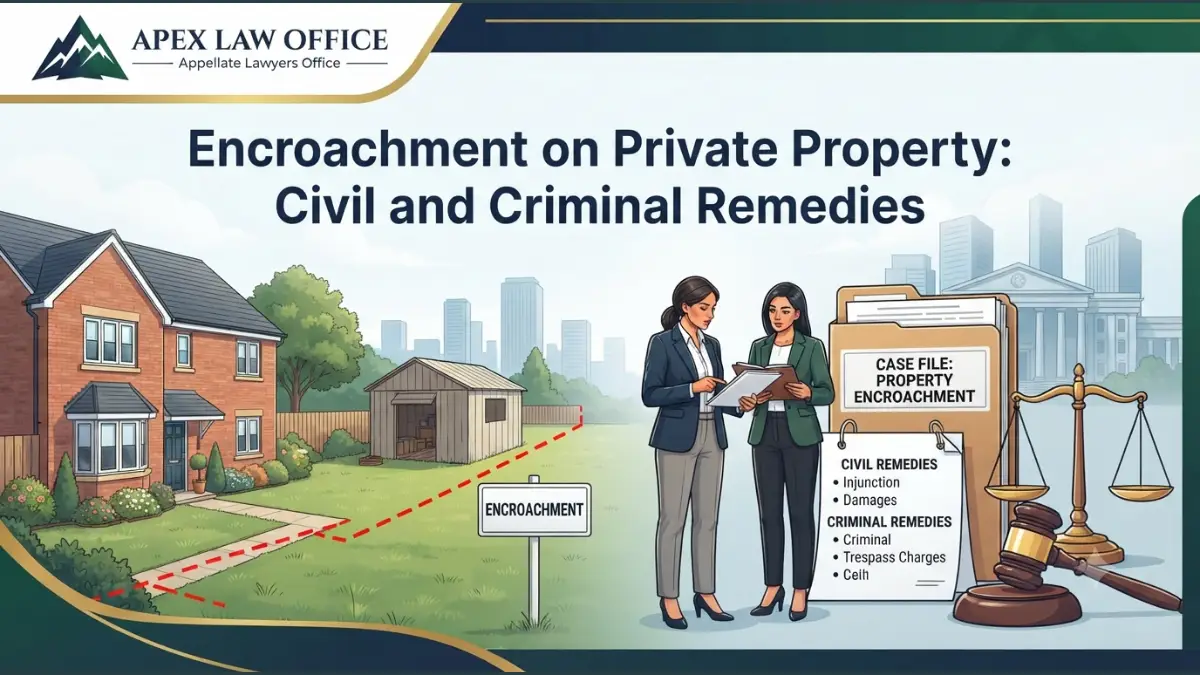
Introduction: Protecting Ownership, Possession and Property Boundaries
Private property encroachment can disrupt ownership rights, peaceful possession and lawful enjoyment of land. Therefore, property owners should identify the encroachment promptly and preserve reliable evidence. An encroachment may involve unlawful construction, boundary extension, occupation, access obstruction or unauthorized use. Sometimes, adjoining owners mistakenly occupy small portions because boundary markings remain unclear. However, deliberate occupation can create serious civil and criminal consequences. Property disputes often involve title documents, survey records, possession evidence, municipal approvals and revenue records. Therefore, owners should avoid physical confrontation and seek structured legal assistance. A civil action can seek possession, declaration, injunction and monetary relief. Criminal proceedings may apply when facts establish criminal trespass, intimidation, mischief or related offences. Moreover, revenue authorities and local bodies may assist where public land or municipal limits are involved. Courts examine title, possession, boundaries and documentary evidence carefully. Hence, an effective strategy should combine accurate property verification, appropriate notices and timely court proceedings. The following guide explains the available remedies, forums and practical legal steps for Chennai property disputes.
Understanding Private Property Encroachment and Legal Rights
Identifying Different Forms of Property Encroachment
Boundary Encroachment and Unauthorized Construction
Boundary encroachment occurs when a person occupies land beyond the legally recognized property boundary. The dispute may involve compound walls, buildings, sheds, gates, pathways or permanent structures. Sometimes, old survey stones no longer match modern measurements. Therefore, owners should compare registered deeds with official survey records and approved plans. A licensed surveyor can measure the property and identify the disputed portion accurately. However, a survey alone does not finally determine legal title. Courts may examine title deeds, parent documents, revenue records and previous transactions. Therefore, owners should preserve every document showing the property’s identity and extent. Important evidence may include:
- Registered sale deeds and previous conveyances.
- Patta, survey records and field measurement documents.
- Approved building plans and municipal records.
- Photographs showing the boundary and alleged encroachment.
- Tax receipts and possession-related documents.
A properly documented boundary dispute can become easier to present before the competent civil court. Moreover, professional legal advice can prevent unnecessary allegations against neighboring owners.
Common Patterns of Encroachment
Encroachment can develop gradually through construction, occupation or alteration of existing boundaries. A neighbour may extend a wall several feet into adjoining land. Alternatively, a person may occupy an open strip beside a building. Some disputes involve unauthorized parking, access obstruction or construction over disputed land. Therefore, identifying the exact nature of interference remains important before filing proceedings. The following patterns frequently create private property disputes:
- Compound wall extending beyond the documented boundary.
- Building construction crossing a survey line.
- Temporary structures occupying another person’s land.
- Unauthorized access roads crossing private property.
- Storage or commercial use over adjoining land.
- Fencing that gradually changes the apparent boundary.
Each pattern may require a different legal response. For example, a continuing construction threat may justify urgent injunctive relief. However, an existing structure may require possession and mandatory removal proceedings. Consequently, legal strategy should follow the actual facts and available evidence.
Documents Required for Boundary Verification
Property owners should collect a complete document set before challenging an alleged encroachment. The registered sale deed usually provides the starting point for identifying the property. However, older parent documents may clarify boundaries and historical descriptions. Revenue records can provide additional information about survey numbers and recorded possession. Therefore, lawyers often examine several records together rather than relying on one document. Useful records include:
- Current and previous registered title deeds.
- Encumbrance certificates and registration extracts.
- Patta, chitta, adangal and field measurement records.
- Approved layouts, plans and planning permissions.
- Property tax assessments and payment records.
- Survey sketches and subdivision documents.
- Photographs, videos and dated correspondence.
The Bharatiya Sakshya Adhiniyam, 2023 recognizes electronic or digital records subject to its statutory requirements. Therefore, properly preserved photographs and digital material can assist litigation. However, owners should preserve original documents whenever possible. A lawyer can also identify missing records and recommend certified copies from relevant authorities.
Possession, Title and Trespass
Ownership and possession represent related but distinct concepts in property litigation. A registered title may establish ownership, while possession evidence may establish physical control. Therefore, an encroachment dispute can involve both title and possession questions. Courts may examine who possessed the property and how that possession arose. The Supreme Court has emphasized the legal protection available to peaceful and settled possession. It has also cautioned against forcible eviction of a person in settled possession. Consequently, owners should not remove structures through private force. Instead, they should use lawful civil remedies and appropriate enforcement mechanisms. The Specific Relief Act provides routes for recovery of immovable property and protection against unlawful dispossession. A Section 6 proceeding can become particularly time-sensitive after unlawful dispossession. Therefore, immediate legal consultation becomes important after an actual loss of possession. The limitation framework also requires careful examination of the nature of the possession claim.
Peaceful Possession and Immediate Protection
Peaceful possession can receive legal protection even when competing title claims exist. The Supreme Court has recognized protection for settled possession against forcible interference. Therefore, property owners should avoid physically evicting alleged encroachers. Such conduct may create additional criminal or civil complications. Instead, owners should document the interference and seek suitable court protection. A temporary injunction can prevent further construction or alteration during litigation. A permanent injunction can address continuing interference after final adjudication. Moreover, possession claims should clearly identify the property using reliable descriptions. Survey numbers, boundaries, measurements and schedules should remain consistent across pleadings. A mismatch can create unnecessary disputes during trial and execution. Therefore, lawyers should verify the plaint schedule before filing the case. Photographs should also show the location, boundary marks and alleged construction. Witness statements can explain possession, prior boundaries and the timing of interference. Consequently, prompt evidence collection can significantly strengthen the owner’s litigation position.
Adverse Possession and Limitation Concerns
Long possession by an encroacher can raise limitation and adverse possession issues. However, mere occupation does not automatically establish adverse possession. The legal analysis depends on the character, continuity and circumstances of possession. Article 64 addresses certain possession suits based on previous possession and dispossession. Article 65 concerns possession claims based on title where adverse possession becomes relevant. Both provisions generally involve a twelve-year limitation period for the described categories. Therefore, owners should not ignore an encroachment because it appears minor. Delay may complicate evidence, limitation analysis and eventual recovery. Property owners should identify the date when the alleged encroachment began. They should also preserve earlier photographs, notices, tax records and survey evidence. A legal notice may clarify the owner’s objection and prevent ambiguity. However, a notice alone does not necessarily restore possession. Therefore, appropriate proceedings should follow when negotiations fail. Lawyers should assess limitation separately because facts differ between boundary disputes and dispossession claims.
Jurisdiction, Authorities and Appropriate Forums
Civil Courts and Property Jurisdiction
Private property encroachment normally requires consideration before a competent civil court. Jurisdiction can depend on the property’s location, monetary value and applicable procedural rules. The Code of Civil Procedure governs civil suits and related procedural matters. Therefore, lawyers should identify the appropriate court before drafting the plaint. A suit may seek declaration, possession, permanent injunction or mandatory injunction. The relief should match the owner’s legal right and factual circumstances. Courts may also consider interim applications during pending litigation. Such applications can seek temporary protection against further construction or interference. Therefore, timely filing can preserve the property’s condition during adjudication. The plaint should clearly identify the property through a precise schedule. It should also explain the title chain and possession history. Supporting documents should correspond with the pleadings and property description. Consequently, careful jurisdictional analysis reduces procedural objections and avoidable litigation delays.
Territorial and Monetary Jurisdiction
Territorial jurisdiction generally connects the dispute with the location of the immovable property. Monetary jurisdiction may also affect which civil court hears the matter. Therefore, lawyers should examine applicable Tamil Nadu court jurisdiction rules before filing. Property valuation can influence court fees and jurisdictional considerations. The exact forum depends upon the nature and valuation of the relief claimed. A title dispute may also require broader relief than a simple injunction. Consequently, owners should avoid copying standard plaint formats without factual analysis. The following preliminary checks can assist forum selection:
- Confirm the property’s exact location and survey identity.
- Verify the applicable territorial jurisdiction.
- Assess the nature and valuation of the relief.
- Identify required court fees and procedural requirements.
- Check pending litigation involving the same property.
- Examine limitation before filing the proposed suit.
A lawyer can then prepare pleadings suitable for the selected forum. This approach reduces the risk of returning or restructuring the proceeding later.
Revenue Authorities and Local Bodies
Revenue and local authorities can become relevant when records, surveys or public land issues arise. The Chennai District Administration identifies encroachment and land-related matters within its administrative functions. However, revenue proceedings do not replace every civil remedy concerning private title. A civil court may remain necessary when ownership or possession requires judicial determination. Therefore, parties should identify the exact administrative issue before approaching an authority. For example, a survey request differs from a title declaration suit. Similarly, a municipal complaint differs from a private possession action. The appropriate authority may include revenue officials, survey authorities, planning authorities or municipal officers. Consequently, the remedy should correspond with the authority’s statutory power. Owners should retain acknowledgment numbers and copies of every representation. These records can later demonstrate earlier complaints and official responses. Therefore, administrative action can complement civil proceedings without automatically replacing them.
Patta, Survey and Land Records
Patta records can assist property identification, but they should not automatically be treated as conclusive title documents. Registered conveyances and parent documents may carry greater relevance for ownership questions. Therefore, discrepancies between title deeds and revenue records require careful examination. A survey can help establish physical measurements and boundary locations. Owners should request appropriate survey services through competent Tamil Nadu authorities. They should also compare the resulting measurements with registered schedules. Where subdivision occurred, subdivision records require particular attention. A boundary dispute may result from an incorrect subdivision or historical measurement. Therefore, a lawyer should examine the entire record chain before asserting encroachment. Important checks include:
- Survey number consistency.
- Subdivision number consistency.
- Extent stated in registered documents.
- Boundary descriptions.
- Field measurement records.
- Patta and revenue entries.
- Approved layout or planning documents.
This evidence can support negotiations, notices and court proceedings. However, disputed title questions may still require adjudication by a competent civil court.
Greater Chennai Corporation and Public Encroachment
A private property dispute should be distinguished from encroachment upon public roads or municipal property. The Greater Chennai Corporation operates a public grievance system and provides the 1913 complaint channel. Its municipal framework also addresses removal of encroachments affecting streets and public places. Therefore, public encroachment complaints can involve municipal enforcement mechanisms. Private boundary disputes require additional attention to title and possession. Owners should avoid presenting a purely private dispute as a municipal encroachment complaint. Instead, they should identify whether the disputed portion belongs to the municipality or the private owner. Photographs, survey records and location details can support an administrative complaint. The GCC grievance portal permits complaint registration and document or photograph uploads. Therefore, affected residents should preserve the complaint number and action history. Legal counsel can coordinate administrative and civil strategies where both issues overlap.
Civil Remedies for Encroachment and Property Recovery
Drafting an Effective Civil Property Suit
Declaration, Possession and Mandatory Relief
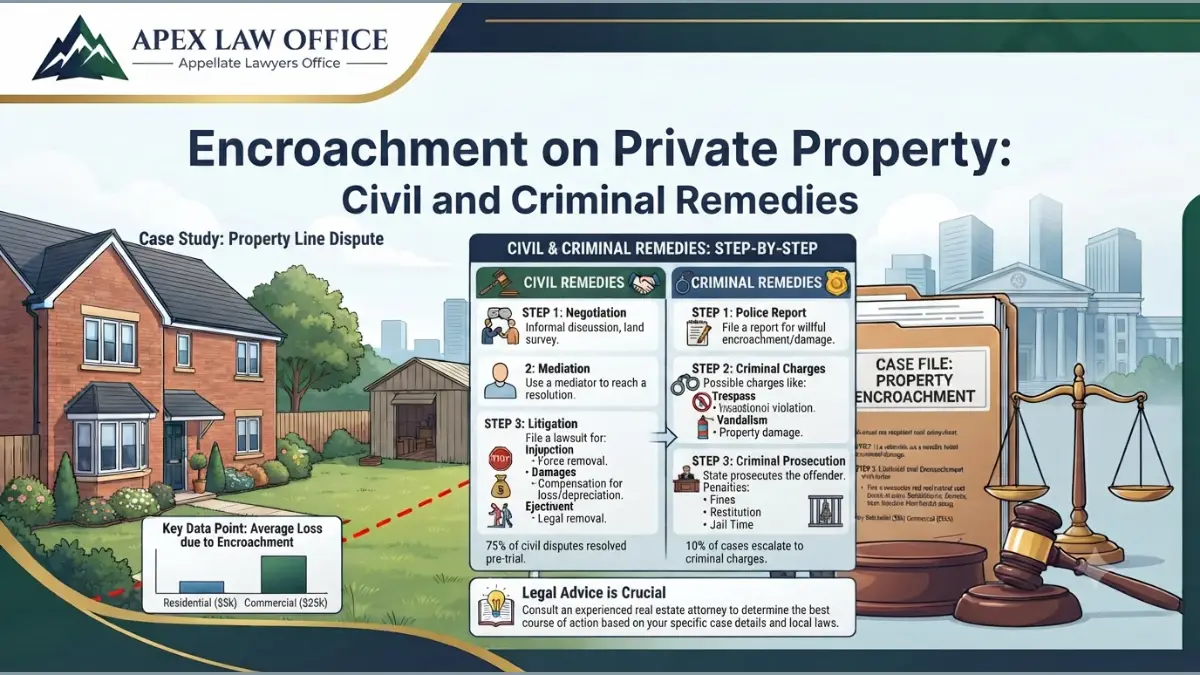
Civil litigation should seek remedies that correspond directly with the owner’s legal rights. A declaration may become necessary when the defendant disputes ownership or title. Recovery of possession may become necessary when the owner has lost physical control. Permanent injunction can restrain continuing interference with lawful possession or ownership. Mandatory injunction may seek removal of an unlawful structure or obstruction. The Specific Relief Act recognizes recovery of specific immovable property and injunction-based remedies. Therefore, lawyers should frame reliefs carefully instead of seeking only a generic injunction. The following remedies may arise depending upon the facts:
| Legal issue | Possible civil relief |
|---|---|
| Title dispute | Declaration of title |
| Dispossession | Recovery of possession |
| Continuing interference | Permanent injunction |
| Unauthorized structure | Mandatory injunction |
| Loss from occupation | Mesne profits |
| Urgent threat | Temporary injunction |
The plaint should also identify the correct parties and property description. Consequently, precise pleadings can improve the court’s ability to grant effective relief.
Mesne Profits and Financial Claims
An encroacher may obtain economic benefit from unlawfully occupying another person’s property. Depending upon the facts, the owner may seek mesne profits for wrongful possession. The CPC contains provisions concerning decrees for possession and mesne profits in appropriate suits. The claimant should provide a factual basis for the financial claim. Rental value, commercial use and comparable property evidence may become relevant. However, courts determine recoverable amounts based on applicable evidence and law. Therefore, owners should not insert arbitrary figures without supporting material. A valuation professional may assist when the property generated measurable rental or commercial benefits. Tax records, lease rates and market evidence can support the claim. Moreover, the claimant should establish the period of wrongful occupation accurately. Delay can create evidentiary difficulties concerning historical rental values. Therefore, financial relief should be pleaded with clarity and supported by documents. Legal counsel can determine whether an inquiry into mesne profits should be requested.
Mandatory Injunction and Removal of Encroachment
Mandatory injunction can become relevant when an existing encroachment requires physical removal. Such relief differs from a simple order preventing future interference. The claimant may need to establish a clear legal right and unlawful obstruction. Examples include an unauthorized wall, gate, structure or permanent obstruction. Courts assess the facts, evidence and applicable principles before granting mandatory relief. Therefore, survey evidence can become especially important in structural encroachment cases. A commissioner-assisted inspection may also help clarify the physical condition. However, the court decides the dispute based on the pleadings and admissible evidence. Owners should avoid demolishing disputed structures themselves. Such action can create allegations of trespass, mischief or unlawful force. Instead, a decree should be obtained and enforced through lawful court procedures. Therefore, mandatory injunction litigation should focus on precise identification of the offending structure. Clear photographs and measurements can improve the factual presentation.
Interim Protection During Pending Litigation
Temporary Injunctions and Status Quo Orders
Encroachment litigation can become difficult when construction continues during the case. Therefore, owners may consider seeking temporary injunction relief at the appropriate stage. The court can examine whether immediate protection is justified under the applicable procedural principles. The applicant should establish a credible legal right and explain the threatened injury. Courts also consider the balance of convenience and the possibility of irreparable harm. Therefore, an application should contain specific facts rather than general allegations. Photographs showing continuing construction can support an urgent application. Survey reports can also demonstrate the disputed area. Previous notices may establish that the defendant knew about the objection. Consequently, evidence should accompany the interim application whenever available. A temporary order can help preserve the property’s condition until further hearing. However, parties must comply strictly with every court direction. Violating an injunction can create serious procedural consequences. Therefore, owners should obtain legal advice before taking any action after an interim order.
Court Commissioner and Local Inspection
A court-appointed commissioner may assist when physical inspection can clarify disputed property facts. Such inspection can document structures, boundaries, access points and physical conditions. However, a commissioner does not normally decide final title questions. The commissioner instead assists the court by recording relevant physical features. Therefore, the application should clearly explain why local inspection becomes necessary. Photographs, measurements and location details can form part of the inspection record. Lawyers should ensure that the property schedule remains consistent with the inspection request. Otherwise, the inspection may create confusion rather than clarity. A survey professional may also assist with technical measurements where permitted. The court will determine the scope and usefulness of the commission. Therefore, parties should avoid treating a commission as a substitute for trial evidence. A carefully framed application can help preserve physical evidence. Consequently, commissioner proceedings can become valuable in complicated boundary and construction disputes.
Appeals, Execution and Continuing Legal Support
Enforcement of Civil Decrees
Obtaining a decree represents an important stage, but enforcement may require additional proceedings. A successful owner may need execution proceedings when the judgment debtor does not comply voluntarily. The CPC contains procedures governing execution of decrees. Therefore, lawyers should prepare an enforcement strategy alongside the original litigation strategy. The execution process may involve delivery of possession, removal of obstructions or other court-authorized measures. Owners should not assume that a decree permits private force. Court-supervised enforcement provides a safer legal route. Consequently, certified copies of judgments and decrees should be preserved carefully. The execution application should identify the relief requiring enforcement. Any continuing obstruction should be documented after judgment. Therefore, owners should maintain photographs and correspondence even after obtaining a decree. If the defendant challenges execution, counsel can respond within the prescribed procedural framework. Effective post-decree representation can therefore be as important as trial representation.
Appeals and Property Litigation Strategy
An adverse civil order may create appellate or revisional remedies depending upon the nature of the decision. However, not every order carries the same appeal rights. Therefore, lawyers must identify the precise order, statutory provision and procedural stage. The appellate court may examine questions of fact, law or both, depending upon the proceeding. Property disputes can also reach the High Court through appropriate appellate jurisdiction. The Supreme Court remains the final constitutional and statutory appellate forum in qualifying matters. Its case categories expressly include property succession and several land and encroachment-related subjects. Therefore, appellate strategy should begin by preserving objections during the trial. Documentary contradictions should be identified before final arguments. Survey evidence and title-chain issues should receive careful attention. Consequently, a complete trial record can materially assist appellate review. Lawyers should also monitor limitation for filing appeals. Delay may require additional procedural applications and supporting explanations.
Criminal Remedies for Encroachment, Trespass and Threats
BNS Criminal Trespass and Related Offences
Criminal Trespass, Damage and Intimidation
A property dispute can have criminal dimensions when facts satisfy statutory offence requirements. Section 329 of the Bharatiya Nyaya Sanhita, 2023 addresses criminal trespass and house-trespass. The provision covers unlawful entry or continued presence with specified criminal intent. Therefore, every boundary dispute should not automatically become a criminal trespass case. Police and courts examine the facts and statutory ingredients of the alleged offence. Criminal allegations may also arise where threats, intimidation, property damage or other offences occur. Consequently, complainants should provide specific facts instead of merely describing ownership disagreement. Photographs can show damage or unauthorized entry. Witness statements can establish threats, entry or continuing conduct. Digital messages may also support allegations when legally admissible. The criminal process does not automatically decide private title. Therefore, civil proceedings may still remain necessary for possession or ownership relief. A coordinated strategy can address both criminal conduct and underlying property rights.
FAQs
1. What is private property encroachment?
Private property encroachment occurs when someone unlawfully occupies, constructs upon, obstructs, or uses another person’s land without valid legal authority.
2. Can an owner file a civil suit for encroachment?
Yes. Depending on the facts, an owner may seek declaration, possession, permanent injunction, mandatory injunction and mesne profits.
3. Is encroachment always a criminal offence?
No. Criminal liability depends on statutory ingredients. Criminal trespass under BNS requires specified unlawful entry or continued presence with required intent.
4. Can police intervene in an encroachment dispute?
Police may investigate offences disclosed by the complaint. However, disputed ownership and possession questions often require appropriate civil proceedings.
5. Can an encroachment structure be demolished immediately?
Owners should avoid self-help demolition. Court orders or lawful administrative action should normally precede removal where rights remain disputed.
6. Which documents help prove property encroachment?
Useful evidence includes registered deeds, parent documents, survey records, patta, tax records, photographs, approved plans, notices and admissible digital records.
Legal Support for Chennai Property Encroachment Disputes
Apex Law Office can assist property owners with title verification, boundary disputes and encroachment litigation. Legal support may include document review, survey coordination, legal notices and civil pleadings. Counsel can also advise on injunction applications and possession recovery proceedings. Where criminal conduct appears, lawyers can assist with complaint preparation and procedural remedies. The BNSS provides the current statutory framework for investigation of cognizable cases. Therefore, complainants should preserve complaint acknowledgments and investigation-related communications. In Chennai, the appropriate police station depends upon the property’s actual location. The Chennai District administration also publishes official public-service information and helpline details. The Greater Chennai Corporation operates its 1913 grievance system for relevant municipal complaints. Property owners should therefore avoid relying on informal intervention alone. A structured legal approach can coordinate civil, criminal, revenue and municipal remedies. Ultimately, the correct forum depends upon title, possession, location, evidence and the exact nature of encroachment.
Legal Disclaimer: This article provides general legal information for educational and SEO purposes. Property disputes depend upon title documents, possession history, limitation, survey records, pleadings and applicable Tamil Nadu procedures. Specific legal advice should follow examination of the complete case record.


