
Introduction: Legal Recovery of Property from an Illegal Occupant
Recovering property from an illegal occupant requires careful legal planning and proper evidence. Owners should avoid threats, force, unlawful eviction, or damage to the occupant’s belongings. Instead, they should establish ownership, possession rights, and the legal basis for recovery. Property disputes may involve trespassers, former tenants, licensees, relatives, encroachers, or persons claiming an unsupported ownership interest. Therefore, the correct remedy depends upon the occupant’s original entry and present legal status. The Civil Procedure Code, 1908 governs many civil proceedings involving possession, injunctions, declarations, and execution. The Specific Relief Act, 1963 provides important remedies concerning possession and specific relief. (indiacode.nic.in) Additionally, the Bharatiya Nyaya Sanhita, 2023 may apply where conduct involves criminal trespass, cheating, forgery, or criminal breach of trust. (indiacode.nic.in) Apex Law Office [Appellate Lawyers Office] assists property owners with title review, possession claims, injunctions, appeals, execution proceedings, and related criminal remedies.
Identify the Occupant and Establish Your Legal Rights
Types of Illegal Occupation in India
Trespasser Without Any Ownership Claim
A trespasser enters or remains on property without lawful permission or a valid legal interest. Therefore, the owner should first collect documents proving title and prior possession. Relevant records may include sale deeds, gift deeds, settlement deeds, partition deeds, and approved plans. Additionally, property tax receipts and electricity records can support possession history. However, tax receipts alone may not establish absolute ownership. Courts examine title documents, possession evidence, and competing claims together. Consequently, owners should prepare a complete document chronology before taking action. Photographs, boundary records, survey plans, and witness statements may also support the case. Furthermore, owners should verify whether the occupant claims tenancy, licence, inheritance, or adverse possession. A person who entered with permission may require a different legal process. Therefore, the owner should not describe every unwanted occupant as a trespasser automatically. Legal classification determines the notice, suit, forum, and remedy. Proper preliminary analysis can prevent an unsuccessful or incorrectly framed possession case.
Former Tenant or Licensee
Former tenants and licensees may remain after their permission expires or their agreement ends. Therefore, the owner should examine the lease, licence, rent receipts, and termination correspondence. A tenant may possess statutory protection under applicable rent-control legislation. However, a licensee generally holds a different legal position from a tenant. Consequently, the court must identify the true nature of the arrangement. Written agreements provide useful evidence, but conduct may also influence legal interpretation. Additionally, rent payments, maintenance arrangements, and exclusive possession can become relevant. A valid termination notice may be necessary before filing an eviction or possession proceeding. Furthermore, the owner should avoid accepting rent after termination without legal advice. Such conduct may create arguments concerning continuation or waiver. The appropriate forum may depend upon the property location and applicable tenancy law. Therefore, owners should obtain a legal opinion before changing locks or disconnecting services. A carefully prepared notice can clarify the demand for vacant possession. It may also create an opportunity for negotiated settlement.
Relative, Caretaker, or Unauthorised Licensee
Family members, caretakers, domestic workers, and informal occupants may claim permission to remain. Therefore, the owner should identify how the person entered and what permission existed. Oral arrangements can create factual disputes concerning duration and conditions. Additionally, family relationships do not automatically create ownership rights. However, inheritance, co-ownership, maintenance, and residence rights may affect the analysis. Consequently, the owner should examine family documents and previous arrangements. A caretaker may have entered only to protect or manage the property. A relative may claim a share through succession or a previous family settlement. Furthermore, a former licensee may argue that permission never ended. Lawyers can review messages, affidavits, payment records, and witness statements. The owner should then issue a clear written demand for possession. If the occupant disputes title, a declaration and possession suit may become necessary. Therefore, the legal strategy should address both possession and the underlying claim. Early advice can prevent unnecessary criminal allegations against family members.
Encroacher on Land or Common Property
Encroachment can involve boundary expansion, construction, fencing, pathway obstruction, or occupation of public land. Therefore, owners should obtain an accurate survey before making allegations. Survey sketches, field measurement books, approved plans, and revenue records may become important. Additionally, municipal or revenue authorities may have jurisdiction over particular encroachment issues. However, administrative complaints may not replace a civil title or possession suit. Consequently, the owner should identify whether the land belongs privately, jointly, municipally, or to another public authority. Encroachment disputes may also involve roads, water channels, access pathways, or common areas. Furthermore, unauthorised construction can create separate municipal-law consequences. A lawyer can coordinate with the Sub-Registrar, Tahsildar, Corporation, Revenue Department, or planning authority. The correct authority depends upon the land classification and alleged violation. Therefore, owners should avoid relying solely on informal local complaints. Proper survey evidence can clarify the exact area under dispute. It can also reduce boundary-related confusion during court proceedings.
Documents Required for Property Recovery
Title and Registration Records
Title documents provide the foundation for most property recovery proceedings. Therefore, owners should collect the registered sale deed and earlier parent documents. Gift deeds, settlement deeds, partition deeds, release deeds, and court decrees may also matter. Additionally, an encumbrance certificate can reveal registered transactions affecting the property. However, an encumbrance certificate does not prove every possible interest. Unregistered arrangements, pending claims, and certain possession rights may remain outside its scope. Consequently, lawyers should examine the entire title chain. Revenue records, patta, chitta, adangal, and property tax records may support the factual history. Furthermore, approved building plans can establish the authorised structure and boundaries. Owners should obtain certified copies when originals are unavailable. A title search can identify mortgages, prior transfers, and competing claims. Therefore, document review should precede any recovery notice. A strong title record improves the prospects of obtaining possession and interim protection. It also assists appellate lawyers when challenging an adverse order.
Possession and Occupation Evidence
Possession evidence helps establish who controlled the property before the dispute. Therefore, owners should preserve photographs, utility bills, tax payments, maintenance records, and caretaker statements. Security-camera footage may show entry, construction, or changes in occupation. Additionally, neighbours can provide evidence about possession and access. However, witness statements should remain accurate and consistent. Fabricated or exaggerated evidence can damage the owner’s credibility. Consequently, owners should preserve original files and avoid editing photographs or recordings. Electricity connection records may help establish the date of occupation. Rent receipts can clarify whether the occupant entered as a tenant. Furthermore, correspondence may reveal permission, termination, or acknowledgment of ownership. Lawyers can organise the evidence into a chronological possession chart. This chart can identify gaps requiring additional documents. Therefore, possession evidence should support, rather than replace, title proof. A combined title and possession record creates a clearer litigation strategy.
Notices, Complaints, and Communication Records
Written communication can demonstrate that the owner demanded lawful recovery. Therefore, owners should send a carefully drafted legal notice through appropriate channels. The notice should identify the property, explain the legal right, and demand possession. Additionally, it should specify a reasonable response period where applicable. Threatening language should be avoided because it may create separate allegations. The owner should preserve postal receipts, delivery tracking, emails, and acknowledgment records. Furthermore, messages should remain complete and unaltered. A police complaint may become relevant when the facts disclose a criminal offence. However, police authorities generally cannot decide complicated civil title disputes. Consequently, owners should not expect a police complaint to replace a possession suit. Lawyers can distinguish civil remedies from criminal remedies. They can also advise whether a complaint concerns trespass, forgery, cheating, intimidation, or misappropriation. Proper communication may encourage voluntary surrender. It also creates evidence of the owner’s lawful conduct.
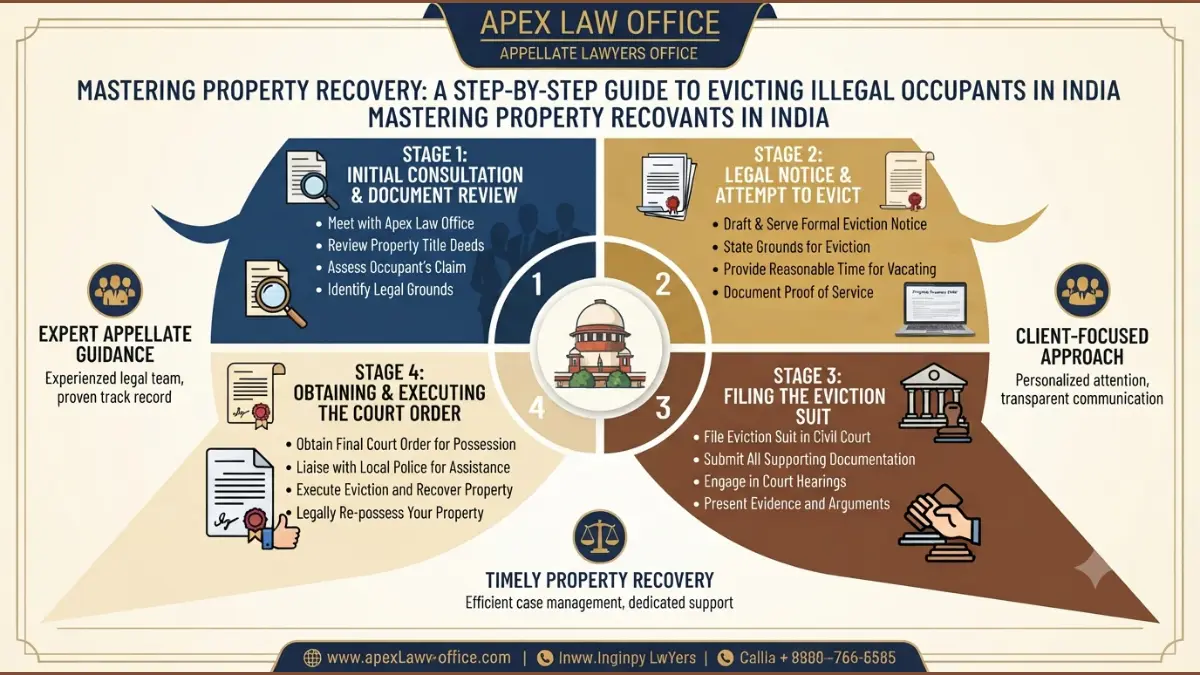
Civil Proceedings and Criminal Remedies
Choosing the Correct Court and Forum
Civil Court for Possession and Title
A civil court usually handles disputes involving ownership, possession, declaration, partition, and injunction. Therefore, the owner should identify the court having territorial and pecuniary jurisdiction. Property location often influences territorial jurisdiction in immovable-property litigation. The Civil Procedure Code, 1908 provides procedural rules for civil suits and related applications. Additionally, the suit must include necessary parties and disclose the material facts. A possession suit may seek recovery from an occupant without lawful entitlement. A declaration may become necessary when the occupant disputes the owner’s title. Furthermore, an injunction may prevent sale, construction, damage, or interference. Courts examine pleadings, documents, witness testimony, and applicable limitation rules. Consequently, owners should avoid filing a bare possession claim when title remains seriously disputed. Lawyers can assess whether the case requires declaration, cancellation, partition, or possession. Proper court selection prevents jurisdictional objections and procedural delay. It also helps the owner pursue effective interim protection.
High Court and Appellate Jurisdiction
The High Court may become involved through appeals, revisions, writ petitions, or supervisory jurisdiction. Therefore, an adverse trial-court order should receive prompt legal review. Appeals depend upon the nature of the judgment, applicable statute, and limitation period. Additionally, an appellate court generally examines the grounds raised within the permitted jurisdiction. A party should obtain the certified judgment and complete lower-court record. Furthermore, interim protection may require a separate stay application. The High Court may examine jurisdictional errors, legal misinterpretation, procedural irregularities, or evidentiary issues. However, appellate intervention depends upon the specific facts and governing law. Consequently, owners should not assume that every adverse order automatically receives a stay. An appellate lawyer can identify the correct remedy and formulate precise grounds. Proper record preparation improves the clarity of the challenge. Therefore, timely advice becomes important after any disputed interim or final order.
Tribunal, Revenue, and Municipal Authorities
Some property disputes involve authorities outside ordinary civil courts. Revenue authorities may address land records, classification, mutation, or government-land encroachment. Municipal authorities may address unauthorised construction, building approvals, and public access obstruction. Housing or rent tribunals may have jurisdiction under special legislation. Therefore, the owner should identify the authority empowered to grant the requested relief. Administrative proceedings may support a civil case but may not determine final private title. Additionally, special statutes can restrict ordinary civil-court jurisdiction in particular matters. Consequently, legal counsel should examine the relevant legislation before filing. Applications should include survey records, title documents, photographs, and previous orders. Furthermore, parties should comply with notice and hearing requirements. An administrative order may remain challengeable through appeal or judicial review. Therefore, the correct forum depends upon the land’s nature and the remedy sought. Coordinated proceedings can prevent contradictory applications and unnecessary delay.
Legal Remedies for Recovering Possession
Suit for Recovery of Possession
A suit for recovery of possession seeks restoration of property to the person legally entitled to possess it. Therefore, the plaint should describe the property precisely. It should also explain the plaintiff’s title, previous possession, and the defendant’s unlawful occupation. Additionally, the pleading should identify the date and manner of dispossession where relevant. The Specific Relief Act contains provisions concerning recovery of possession and specific relief. (indiacode.nic.in) Courts may examine whether the plaintiff proves a better right to possession. Consequently, the owner should attach relevant title and possession documents. A court may also consider limitation, court fees, valuation, and necessary parties. Furthermore, the owner should disclose any pending connected litigation. Lawyers can seek interim protection against further construction or transfer. A final decree may direct delivery of possession through lawful execution. Therefore, owners should understand that filing a suit does not itself restore possession. Execution proceedings may become necessary after judgment.
Summary Possession Remedy
Certain possession disputes may qualify for summary relief under the Specific Relief Act. Section 6 addresses recovery of possession in specified circumstances following dispossession. (indiacode.nic.in) Therefore, the owner should examine the date and circumstances of dispossession immediately. Summary proceedings may involve strict statutory conditions and limitation requirements. Additionally, the court may focus on prior possession rather than final title. Consequently, this remedy differs from a comprehensive title suit. A party should not delay while considering whether summary relief remains available. Lawyers can assess the evidence of previous possession and the alleged dispossession. Furthermore, the owner may need a separate title action where ownership remains disputed. The remedy does not authorise private force or self-help eviction. Therefore, lawful court procedure remains essential. A timely application can protect possession rights where the statutory conditions exist. Owners should obtain advice quickly because limitation can affect availability.
Injunction Against Sale or Further Construction
An illegal occupant may attempt to sell, mortgage, alter, or develop the disputed property. Therefore, the owner may seek temporary and permanent injunctions. A temporary injunction can preserve the property during litigation. The application should explain the legal right, threatened harm, and need for protection. Additionally, photographs and recent construction records may support urgency. Courts assess the relevant legal principles before granting interim relief. Consequently, applicants should provide accurate and complete information. An injunction does not automatically decide final ownership. Instead, it protects the subject matter until the court determines the dispute. Furthermore, the owner should monitor compliance with every order. Breach may create additional legal consequences under applicable procedure. Lawyers can seek directions concerning inspection, restraint, preservation, or status quo. Therefore, prompt interim action can prevent the dispute from becoming more complicated. Owners should avoid taking unilateral steps that violate court directions.
Declaration and Cancellation of Documents
A declaration may become necessary when an occupant relies upon a disputed document. Such documents may include forged sale deeds, fabricated releases, invalid powers of attorney, or unauthorised settlements. Therefore, the owner should obtain certified registration records and examine the document’s origin. A cancellation claim may become relevant where the instrument requires judicial invalidation. Additionally, the court may need to determine title before ordering possession. Consequently, the plaint should identify the document, defect, parties, and legal relief. The Specific Relief Act governs important aspects of declaratory and specific relief. (indiacode.nic.in) Lawyers should also examine limitation and court-fee requirements. Furthermore, a criminal complaint may become appropriate when evidence supports forgery or cheating. However, a disputed document does not automatically prove criminal conduct. Courts require evidence concerning the alleged offence. Therefore, civil and criminal strategies should remain separately analysed. Proper drafting can address both title uncertainty and possession consequences.
Execution of Possession Decree
Winning a possession suit does not always result in immediate physical recovery. Therefore, the successful owner may need to initiate execution proceedings. The executing court can implement the decree through lawful procedures. Additionally, the court may issue appropriate directions concerning delivery of possession. The owner should provide the decree, property description, and required execution documents. Furthermore, the decree should identify the persons bound by its terms. If the occupant resists execution, the owner should inform the executing court. Private force can create fresh criminal or civil liability. Consequently, owners should rely upon court-authorised enforcement. Lawyers can monitor warrants, bailiff visits, objections, and delivery records. The executing court generally cannot rewrite the original decree. Therefore, the decree’s wording should be examined carefully before execution begins. Proper execution planning can reduce delay after successful litigation. It also ensures that possession changes occur through lawful authority.
Criminal Law and Police Assistance
Criminal Trespass and Related Offences
Certain conduct may attract criminal liability when a person enters or remains on property with the required criminal intention. The Bharatiya Nyaya Sanhita, 2023 contains provisions concerning criminal trespass and related offences. (indiacode.nic.in) Therefore, the complainant should describe specific conduct and supporting evidence. A mere ownership disagreement does not automatically establish criminal trespass. Additionally, the original permission and purpose of entry may become important. Lawyers should examine whether the facts disclose intimidation, damage, cheating, forgery, or misappropriation. The complaint should identify dates, acts, witnesses, and documents. Furthermore, the complainant should avoid exaggeration or unsupported accusations. Police investigation follows the applicable criminal procedure under the BNSS, 2023. (indiacode.nic.in) A criminal case may proceed separately from a civil possession suit. Consequently, both proceedings require consistent factual positions. Proper legal advice can help determine whether police action is appropriate.
Forgery, Cheating, and Document Fraud
Illegal occupants sometimes rely upon fabricated documents to support possession claims. Therefore, owners should preserve certified copies and compare disputed instruments with registration records. Allegations may concern forged signatures, false powers of attorney, fabricated agreements, or dishonest representations. The BNS may apply where the evidence satisfies the relevant criminal ingredients. (indiacode.nic.in) Additionally, electronic records may require analysis under the Bharatiya Sakshya Adhiniyam, 2023. (indiacode.nic.in) Lawyers can arrange forensic examination where necessary. However, a signature difference alone may not prove forgery. Courts examine authenticity, knowledge, intention, use, and surrounding circumstances. Consequently, the complaint should contain specific factual allegations. A civil declaration or cancellation proceeding may also remain necessary. Therefore, criminal action should complement, not replace, title litigation. Accurate evidence improves the prospects of a fair investigation.
Police Stations and Local Authorities in Chennai
Property owners in Chennai should identify the police station having jurisdiction over the alleged conduct. The correct station may depend upon the location of entry, damage, threats, or document execution. Therefore, owners should verify jurisdiction before submitting a complaint. Additionally, the complaint should attach title documents and a concise chronology. Police authorities may record information where the facts disclose a cognisable offence. However, they generally cannot decide final ownership through a criminal complaint. Consequently, owners should pursue civil remedies where possession and title remain disputed. Revenue and municipal authorities may also become relevant for encroachment or unauthorised construction. Furthermore, owners should retain acknowledgment of every representation. Lawyers can assist with complaint drafting, follow-up, and appropriate escalation. If necessary, legal advice may address applications before the competent Magistrate. Therefore, coordinated action can protect both property rights and procedural fairness. Owners should never attempt forcible eviction through private groups.
Evidence, Appeals, and Practical Recovery Planning
Evidence and Litigation Preparation
Electronic and Documentary Evidence
Property disputes increasingly involve digital communications and electronic documents. Therefore, owners should preserve emails, messages, photographs, videos, payment records, and scanned agreements. The Bharatiya Sakshya Adhiniyam, 2023 provides the current evidence framework. (indiacode.nic.in) Original devices and source files may become relevant to authenticity. Additionally, screenshots should retain surrounding context whenever possible. Lawyers can assess whether electronic records satisfy applicable evidentiary requirements. Furthermore, forensic examination may assist with disputed signatures or altered documents. Owners should avoid deleting messages or editing photographs. Consequently, evidence preservation should begin before sending legal notices. A chronological evidence folder can simplify pleadings and witness preparation. It should contain both favourable and unfavourable documents. Therefore, complete disclosure helps counsel prepare realistic advice. Proper evidence management can strengthen civil, criminal, and appellate proceedings.
Witnesses and Local Inspection
Witnesses can help establish possession, entry, permission, construction, or threats. Therefore, owners should identify neighbours, tenants, caretakers, contractors, and previous occupants. Their statements should describe personal knowledge rather than speculation. Additionally, witnesses should preserve relevant documents and messages. A local inspection may become useful where boundaries or construction remain disputed. Courts may appoint commissioners under applicable procedural rules in suitable cases. Consequently, surveyors and engineers may assist with measurements and structural observations. However, private inspection reports do not automatically bind the court. Lawyers should seek appropriate orders where formal inspection becomes necessary. Furthermore, witness preparation should focus on accurate chronology. Contradictions can weaken an otherwise strong property claim. Therefore, evidence should remain consistent with title documents and pleadings. A well-organised witness list can improve trial preparation. It also assists appellate counsel when reviewing evidentiary findings.
Limitation and Delay
Limitation can affect the availability of possession and title remedies. Therefore, owners should seek advice immediately after discovering unlawful occupation. The applicable period depends upon the nature of the claim and governing law. Additionally, delay may create factual difficulties concerning possession, permission, and document preservation. Courts may examine whether the claim is timely under the relevant statute. Consequently, owners should not assume that continuous ownership removes every limitation issue. Adverse possession arguments may arise in certain factual circumstances. However, such claims require careful examination of legal requirements and evidence. Furthermore, acknowledgments, part payments, or written permissions may affect the analysis. Lawyers should prepare a timeline covering acquisition, possession, permission, dispossession, notices, and complaints. A limitation review should precede final drafting. Therefore, timely legal action can protect available remedies. Owners should avoid relying upon informal promises without written confirmation.
Appeals and Enforcement Strategy
Challenging an Adverse Possession Order
An adverse possession order should receive immediate legal review. Therefore, the owner should obtain the complete judgment and trial record. The appeal must identify specific errors in law, evidence, procedure, or jurisdiction. Additionally, the appellant should examine whether the trial court considered all title documents. Findings concerning possession and limitation often require close analysis. Consequently, appellate counsel should distinguish factual disagreement from a legally sustainable ground. A stay application may become necessary when the order threatens immediate dispossession. However, filing an appeal does not automatically suspend execution. Therefore, the owner should seek appropriate interim protection. Lawyers can prepare the memorandum of appeal and supporting documents. Furthermore, limitation periods should be calculated carefully. Certified copies and court records should be obtained without delay. Proper appellate strategy can preserve the owner’s legal position while the challenge proceeds.
Settlement and Mediation
Settlement may provide a practical solution when the occupant has a negotiable claim. Therefore, owners should assess the strength of title and the cost of prolonged litigation. Mediation can address possession, payment, repairs, access, and withdrawal of claims. Additionally, parties may agree to a time-bound vacating schedule. The settlement should clearly identify the property and every obligation. Furthermore, registration may be necessary for instruments affecting immovable-property rights. Lawyers should examine stamp duty, registration, tax, and enforcement consequences. A written settlement can reduce uncertainty and prevent repeated disputes. However, owners should not surrender valuable rights without informed advice. Consequently, independent legal review remains important before signing. Mediation works best when parties participate voluntarily and disclose relevant information. Therefore, negotiated recovery can complement court proceedings where appropriate. A carefully drafted agreement should include default consequences and implementation steps.
Preventing Future Illegal Occupation
Owners can reduce future disputes through regular document and property management. Therefore, they should maintain updated title records and monitor physical possession. Boundary walls, signage, security arrangements, and periodic inspections may deter encroachment. Additionally, rental and licence agreements should contain clear duration and termination clauses. Identity records and payment documentation should remain organised. Furthermore, owners should avoid informal possession arrangements without written terms. A power of attorney should define authority and duration precisely. Property managers should maintain inspection reports and communication records. Consequently, early detection can prevent small disputes from becoming prolonged litigation. Owners should also review title documents after inheritance, partition, or family settlement. Legal advice can identify risks before property transactions occur. Therefore, preventive planning remains less disruptive than emergency recovery. Apex Law Office [Appellate Lawyers Office] can assist with title review, possession protection, notices, litigation, appeals, and execution strategy.
Frequently Asked Questions
1. Can I remove an illegal occupant without going to court?
You should not use force or damage belongings. Send a legal notice and pursue lawful possession remedies. Court action may become necessary when the occupant refuses to leave.
2. Which court handles property possession disputes?
The competent civil court usually handles possession and title disputes. Jurisdiction depends upon property location, valuation, applicable law, and the relief requested.
3. Can police remove a trespasser?
Police may act when facts disclose a criminal offence. However, police generally cannot decide complicated ownership disputes. A civil possession suit may still become necessary.
4. What documents prove ownership?
Important documents include registered title deeds, parent documents, partition records, encumbrance certificates, and relevant court orders. Revenue and tax records can provide supporting evidence.
5. Can I challenge a forged sale deed?
Yes, appropriate civil remedies may include declaration or cancellation. Criminal proceedings may also apply when evidence supports forgery, cheating, or related offences.
6. What if the occupant claims adverse possession?
A lawyer should examine possession history, permission, continuity, openness, and statutory requirements. The claim requires specific evidence and cannot succeed merely through long occupation.


