
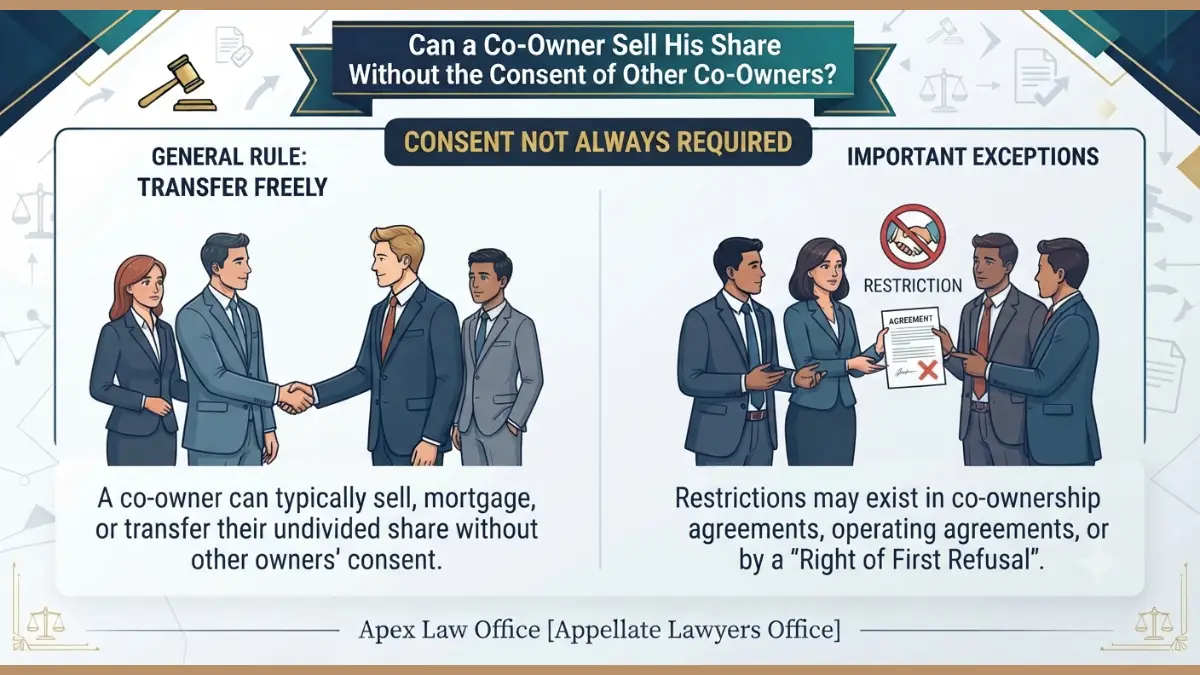
A co-owner generally has the legal ability to transfer his undivided share without obtaining consent from every other co-owner. However, the transfer does not automatically give the buyer exclusive ownership over any specific portion. Section 44 of the Transfer of Property Act, 1882 recognises transfer of a co-owner’s share. The transferee generally receives the transferor’s rights concerning joint possession and partition. Therefore, the legal position differs from selling a separately identified physical portion. Property documents, title history, succession records, existing partition arrangements, and court orders can change the practical outcome. Moreover, disputes may arise when a co-owner sells more than his lawful share. Consequently, buyers and existing co-owners should verify title before completing the transaction. In Chennai, such disputes may involve civil courts, registration authorities, revenue officials, and appellate courts. Legal advice can help determine the transferable interest, appropriate remedies, and correct forum before litigation or registration.
Understanding a Co-Owner’s Right to Transfer Property
What Does an Undivided Share Mean?
Legal Nature of an Undivided Share
An undivided share represents a person’s proportionate ownership in jointly held property. It does not normally identify a particular room, floor, boundary, or physical section. For example, three siblings may own a property equally after succession. Each sibling can possess a one-third undivided interest. However, one sibling cannot automatically claim that the eastern bedroom exclusively represents that interest. The ownership remains collective until a lawful partition separates the interests. Section 44 of the Transfer of Property Act permits a legally competent co-owner to transfer his share. The buyer then obtains rights corresponding to that transferred interest. Therefore, the buyer normally steps into the seller’s legal position regarding the undivided share. The transaction should accurately describe the property and transferred percentage. Otherwise, disputes can arise concerning boundaries, possession, valuation, and title. A property lawyer should examine the title documents before preparing the sale deed.
Difference Between Share and Physical Portion
An undivided share differs substantially from an identified physical portion of property. A co-owner may own 25 percent of a building without owning one specific quarter physically. Therefore, selling a 25 percent undivided share does not automatically transfer a particular room or floor. The distinction becomes important when a buyer expects immediate exclusive possession. Courts generally determine individual possession rights through title documents, partition arrangements, and applicable law. Meanwhile, a partition decree can identify each person’s separate entitlement. The following comparison explains the distinction:
| Issue | Undivided Share | Separate Physical Portion |
|---|---|---|
| Ownership | Proportionate interest | Identified property |
| Boundaries | Usually undivided | Specifically identified |
| Exclusive possession | Not automatic | Usually established |
| Partition | Generally possible | Already separated |
| Buyer’s position | Steps into transferred share | Receives identified interest |
Therefore, purchasers should avoid treating an undivided share as an automatically demarcated property.
Consent of Other Co-Owners
Consent is generally not a universal statutory requirement for transferring an individual co-owner’s lawful undivided share. Section 44 expressly addresses transfers made by one co-owner. Consequently, another co-owner’s disagreement does not necessarily invalidate the transfer. However, the seller cannot lawfully transfer a greater interest than the seller actually owns. Furthermore, contractual restrictions, court injunctions, family arrangements, trusts, mortgages, or statutory restrictions may affect the transaction. A buyer should therefore verify the seller’s exact entitlement. Existing co-owners can challenge transactions that exceed the seller’s lawful interest. They can also seek partition, declaration, injunction, or other suitable remedies. Importantly, an objection to the buyer does not automatically extinguish the seller’s transferable share. The Supreme Court has also considered the rights of outsiders purchasing shares in dwelling-house situations. Hence, each transaction requires document-specific examination. Proper legal due diligence can prevent costly ownership and possession disputes later.
When Can a Co-Owner Sell His Share?
Sale of a Lawful Undivided Interest
A co-owner can generally transfer his lawful undivided interest through an appropriate registered instrument. The seller must establish his title and legal capacity before execution. The sale deed should clearly identify the property and the percentage being transferred. It should also avoid language suggesting exclusive ownership over an unpartitioned physical area. The buyer should examine the parent deed, previous conveyances, encumbrance records, mutation records, tax receipts, and succession documents. Additionally, the parties should verify pending litigation and existing mortgages. Registration requirements become important because instruments creating or transferring interests in immovable property generally require registration under applicable provisions. Therefore, a carefully drafted sale deed reduces future ambiguity. However, registration itself does not cure a defective title. The Sub-Registrar primarily performs statutory registration functions rather than adjudicating every title dispute. Consequently, title verification should occur before registration. An experienced property advocate can examine the transaction from both conveyancing and litigation perspectives.
Sale to Another Co-Owner
A co-owner may transfer his undivided share to another existing co-owner. Such a transaction can simplify ownership because the buyer already holds an interest. The parties should still execute proper documentation and comply with registration requirements. Consideration, stamp duty, registration charges, title descriptions, and tax implications require careful examination. Furthermore, the resulting ownership percentage should be calculated accurately. For example, a co-owner holding 30 percent may transfer the entire 30 percent to another co-owner. The buyer would then hold the combined interests, subject to the remaining co-owners’ rights. Therefore, the transaction should identify both existing and acquired shares clearly. A release deed, sale deed, partition deed, or family settlement may sometimes be more appropriate. The correct instrument depends upon the actual transaction and consideration structure. Legal review can also identify whether pending proceedings affect the proposed transfer. Proper documentation helps prevent later disputes concerning ownership percentages and possession.
Sale to an Outsider
A co-owner may, subject to applicable law, transfer an undivided share to a third party. The outsider does not automatically acquire exclusive possession of a specific physical portion. Section 44 contains an important restriction concerning an undivided family dwelling-house. Where the transferee is not a family member, the provision does not automatically grant joint possession or common enjoyment of that dwelling-house. The Supreme Court has addressed this distinction while considering transfers of shares in family dwelling-houses. Therefore, buyers should understand the difference between purchasing an interest and obtaining physical possession. Existing family members may have statutory protections in appropriate circumstances. The Partition Act, 1893 also contains provisions concerning certain dwelling-house partition situations. Consequently, outsiders should obtain specialist legal advice before purchasing disputed residential shares. A registered sale deed does not eliminate statutory restrictions concerning possession. Instead, the buyer generally acquires the transferor’s lawful interest subject to applicable rights and liabilities.
Consequences, Disputes and Legal Remedies
What Happens After a Co-Owner Sells His Share?
Rights Acquired by the Purchaser
The purchaser generally acquires the seller’s transferable interest rather than a superior title. Section 44 provides that the transferee receives rights concerning joint possession or common enjoyment, subject to statutory limitations. The transferee may also seek partition to separate the acquired interest. Therefore, buying an undivided share can create a legally enforceable ownership interest. However, the buyer cannot normally demand a specific physical portion merely because the sale deed describes a percentage. The existing co-owners retain their respective interests. Consequently, the purchaser should initiate appropriate proceedings if an agreed partition cannot occur. A civil court may determine the respective rights and pass a preliminary decree. The Code of Civil Procedure, 1908 contains procedural provisions governing partition decrees. Therefore, legal advice should address title, possession, limitation, court jurisdiction, valuation, and necessary parties. A purchaser should also investigate whether earlier litigation already affects the property. This approach helps prevent purchasing an interest that carries substantial litigation risk.
Can the Buyer Demand Partition?
A transferee of a co-owner’s share can generally seek partition of the acquired interest. Section 44 specifically recognises the transferee’s right to enforce partition, subject to applicable limitations. A partition suit normally seeks judicial determination of each party’s share. The court may first determine the parties’ respective rights through a preliminary decree. Further proceedings may then implement actual separation where legally and practically possible. Order XX Rule 18 of the CPC addresses decrees concerning partition and separate possession. Therefore, a buyer should not assume that purchasing a share creates immediate physical separation. Instead, the buyer may need a partition proceeding. The court will examine title documents, succession records, prior settlements, admissions, and other evidence. Consequently, a properly prepared plaint and complete documentary record become essential. In Chennai, jurisdiction can depend upon the property’s location and applicable court rules. An appellate lawyer can also assess potential appeals arising from partition judgments or interlocutory orders.
Effect on Existing Co-Owners
Existing co-owners continue holding their lawful shares after another co-owner transfers his interest. Their ownership does not automatically disappear because a new purchaser enters the co-ownership arrangement. However, the identity of one co-owner changes. The purchaser may assert the rights attached to the transferred share. Existing owners should therefore verify whether the seller transferred only his actual entitlement. If the sale deed claims exclusive ownership over common property, disputes may arise. The affected co-owners can seek declaration, cancellation, injunction, partition, or other suitable relief. Furthermore, an interim injunction may become relevant where construction, alienation, or possession threatens the disputed property. Courts examine the pleadings and evidence before granting such relief. Therefore, prompt legal advice becomes important after discovering an unauthorized or excessive transfer. Parties should preserve sale deeds, encumbrance certificates, tax receipts, title deeds, correspondence, and photographs. These records may become relevant under the Bharatiya Sakshya Adhiniyam, 2023.

Challenging an Improper Co-Owner Sale
Sale Beyond the Seller’s Actual Share
A co-owner cannot ordinarily transfer a greater proprietary interest than the seller possesses. Suppose four siblings each own 25 percent of inherited property. One sibling cannot validly convey the other siblings’ 75 percent without lawful authority. The buyer may obtain the seller’s transferable interest, but the remaining owners retain their rights. Therefore, the disputed deed may require judicial examination. A declaration suit can clarify the extent of the buyer’s valid title. Partition proceedings can also determine each owner’s final entitlement. Additionally, an injunction may prevent further transactions involving disputed interests. Courts will examine title documents, succession instruments, previous partitions, and registered conveyances. Consequently, a detailed title investigation should precede litigation. Parties should also examine whether any family settlement, release deed, or court decree changed ownership. If fraud or impersonation appears, separate criminal and civil remedies may become relevant. Legal strategy should therefore distinguish a simple title dispute from an allegation involving dishonest conduct.
Fraud, Forgery and Impersonation
A property dispute can become a criminal matter when evidence indicates forgery, impersonation, cheating, or dishonest document creation. However, an unsuccessful property transaction does not automatically establish a criminal offence. The evidence must support the ingredients of the alleged offence. Since July 2024, criminal proceedings operate under the Bharatiya Nyaya Sanhita, 2023 and Bharatiya Nagarik Suraksha Sanhita, 2023. The Bharatiya Sakshya Adhiniyam, 2023 governs evidentiary principles replacing the earlier evidence statute. Therefore, parties should preserve original deeds, certified copies, registration records, identity documents, correspondence, and electronic communications. A police complaint may be appropriate when facts disclose a cognizable offence. Otherwise, civil proceedings may remain the principal route for resolving title and possession. In Chennai, the appropriate police station depends upon the relevant territorial jurisdiction. Parties should avoid making unsupported criminal allegations merely because another co-owner disputes a sale. A property litigation lawyer can coordinate civil and criminal remedies when the evidence supports both.
Injunction Against Further Alienation
An injunction can become important when a disputed property faces repeated transfers or physical changes. A co-owner may seek temporary protection while the court examines title and possession. The relief sought should correspond to the actual risk. For example, a plaintiff may seek restraint against further alienation or creation of third-party interests. The plaintiff should provide relevant title documents and explain the urgency. Courts consider established legal principles before granting interim relief. Therefore, a bare allegation of ownership may not sufficiently support an injunction. A properly framed plaint should identify every necessary party and explain the disputed transaction. It should also describe the property accurately using survey numbers, boundaries, document numbers, and other identifiers. Consequently, professional drafting can materially improve clarity. Interim orders may also influence later transactions involving the property. Parties should therefore obtain legal advice before negotiating, registering, or developing disputed property during litigation.
Courts, Authorities and Chennai Jurisdiction
Civil Courts and Partition Proceedings
Civil courts ordinarily determine many disputes involving title, partition, declaration, possession, and injunction. The competent court depends upon territorial jurisdiction, valuation, subject matter, and applicable procedural rules. In Chennai, property litigation may therefore involve the appropriate civil court having jurisdiction over the property. The Madras High Court exercises appellate and supervisory jurisdiction in accordance with law. The e-Courts system provides facilities for checking case status, orders, cause lists, and other case information. Therefore, litigants should verify the correct forum before filing proceedings. A partition suit should include all necessary co-owners and relevant transferees. Otherwise, an incomplete proceeding may create additional procedural difficulties. The CPC governs pleadings, interim applications, evidence procedures, decrees, and appeals. Consequently, legal representation should address both substantive property law and civil procedure. Parties should also examine previous judgments affecting the same property. A title search and litigation search can provide important information before initiating or defending proceedings.
Madras High Court Appeals
The Madras High Court can become relevant when a property dispute reaches appellate or supervisory proceedings. An appeal does not function as an automatic rehearing of every factual issue. The maintainability and scope of an appeal depend upon the applicable procedural provisions and nature of the order. Therefore, parties should obtain the complete judgment and decree before deciding the appellate route. Certified copies, limitation calculations, grounds of appeal, and supporting records require careful preparation. The High Court’s e-Courts services provide case-status and order-search facilities. Consequently, litigants can monitor proceedings through official judicial systems. Appellate advocacy requires careful identification of legal errors, evidentiary issues, procedural irregularities, or jurisdictional questions. However, each appeal depends upon its record and applicable statutory framework. A lawyer should therefore avoid relying on generalized assumptions about appeal rights. Early review of the trial record can help identify relevant questions before limitation periods expire.
Revenue and Registration Authorities
Revenue records and registration records play different roles in property transactions. The Sub-Registrar registers documents falling within statutory registration requirements. Revenue authorities maintain records concerning land administration, mutation, patta, and related matters. However, mutation does not necessarily create or extinguish substantive title. Similarly, registration does not guarantee that every title defect has disappeared. Therefore, parties should treat registration records as part of a wider title investigation. The Registration Act, 1908 specifies categories of documents requiring registration. Section 17 contains important compulsory registration provisions concerning specified instruments affecting immovable property. Consequently, parties should identify the correct document before approaching the registration office. In Tamil Nadu, additional state procedures and registration rules may apply. Professional legal review can identify the relevant Sub-Registrar office and documentation requirements. A title dispute may still require a civil court even after registration. Therefore, registration and adjudication should not be confused.
Legal Remedies, Evidence and Practical Protection
Remedies Available to Co-Owners
Declaration of Ownership Rights
A declaration proceeding can clarify the legal status of disputed ownership. It becomes relevant when a sale deed or document allegedly affects another co-owner’s rights. The plaintiff must establish the legal entitlement requiring declaration. Supporting documents may include parent deeds, wills, succession certificates, legal-heir records, partition deeds, release deeds, and registered conveyances. Courts examine the complete chain rather than relying upon one isolated document. Therefore, a carefully prepared title chronology can strengthen the presentation of the dispute. The relief should identify the exact declaration sought and the affected instrument. Furthermore, limitation and court-fee requirements require attention before filing. A declaration alone may not resolve possession or future alienation concerns. Consequently, parties may need consequential injunction or partition relief. The appropriate combination depends upon the factual circumstances. An appellate property lawyer can also assess whether an existing judgment requires appeal rather than a fresh declaration suit. Properly framed relief can reduce procedural objections and duplicated litigation.
Partition and Separate Possession
Partition remains one of the principal remedies when co-owners seek separate ownership. The proceeding determines each party’s lawful share before implementing separation. A court may pass a preliminary decree declaring the parties’ respective rights. Further steps may follow before final separation or delivery of separate possession. Order XX Rule 18 of the CPC addresses partition decrees and separate possession. Therefore, a buyer of an undivided share may pursue partition where appropriate. Existing co-owners can also seek partition when continued joint ownership becomes impractical. The pleadings should identify all co-owners and material transferees. Property schedules should contain accurate survey numbers, boundaries, measurements, and document references. Consequently, title verification becomes essential before filing. A court may also consider previous partition arrangements or family settlements. Legal advice should cover court fees, limitation, valuation, interim relief, and execution. A partition decree can ultimately convert an uncertain shared interest into separately identifiable ownership where physical division remains legally and practically possible.
Cancellation or Setting Aside of Documents
A disputed sale deed may require appropriate relief when allegations involve invalid execution, fraud, lack of authority, or other legal defects. The remedy depends upon the plaintiff’s relationship with the instrument and applicable statutory principles. A person seeking cancellation should identify the legal basis clearly. Courts may examine execution, consideration, authority, title, coercion, fraud, impersonation, and surrounding circumstances. Evidence may include registration records, signatures, identity documents, bank records, correspondence, and witness testimony. The Bharatiya Sakshya Adhiniyam, 2023 contains rules governing documentary and other evidence. Therefore, parties should preserve original documents whenever possible. They should also obtain certified copies from the relevant registration authority. A cancellation claim may need accompanying declaration, injunction, or possession relief. Consequently, selecting the correct remedies at the drafting stage is important. Parties should not assume that merely filing a police complaint automatically cancels a registered conveyance. Civil adjudication may remain necessary to determine proprietary rights.
Evidence Required in Co-Ownership Disputes
Title Documents and Registration Records
Strong documentary evidence often determines the practical direction of property litigation. Parties should collect the earliest parent document and trace every subsequent transfer. Important records may include sale deeds, gift deeds, partition deeds, release deeds, settlement deeds, wills, probate orders, and court decrees. Encumbrance certificates can assist in identifying registered transactions affecting the property. Patta and revenue records may provide additional administrative information. However, each record must be assessed for its legal significance. The Bharatiya Sakshya Adhiniyam, 2023 governs contemporary evidence principles and documentary proof. Consequently, certified copies and properly authenticated records can become important during proceedings. Parties should also preserve electronic communications concerning negotiations or admissions. Photographs and possession records may help establish factual circumstances. Therefore, legal counsel should organize documents chronologically before preparing pleadings. A comprehensive document bundle can also help identify missing links in the chain of title. Early investigation frequently reveals whether the dispute concerns ownership, possession, registration, fraud, or partition.
Encumbrance and Revenue Verification
An encumbrance search can reveal registered transactions affecting a property. It may identify mortgages, sales, settlements, releases, attachments, or other registered instruments. However, an encumbrance certificate does not necessarily reveal every possible claim. Unregistered arrangements, pending litigation, family disputes, and certain statutory interests may require separate investigation. Therefore, a complete title search should examine multiple sources. Revenue records can provide information concerning patta and land administration. Registration records can reveal registered instruments and historical transactions. Court databases can help identify litigation involving relevant parties or property. Consequently, buyers should combine documentary searches with legal analysis. A lawyer can compare the registered chain against succession and possession evidence. Any mismatch should receive attention before payment or registration. This process becomes particularly important when purchasing an undivided share from one family member. A discounted price should never replace proper title verification. The objective should remain identifying the actual interest being purchased and the risks attached to it.
Witnesses and Electronic Evidence
Property disputes may involve oral family arrangements, possession claims, negotiations, or disputed execution. Witness testimony can therefore supplement documentary evidence. However, oral evidence cannot automatically override clear registered instruments. Courts assess relevance, credibility, admissibility, and consistency. Electronic messages, emails, payment records, and digital documents may also become relevant. The Bharatiya Sakshya Adhiniyam, 2023 contains provisions concerning documentary and electronic evidence. Therefore, parties should preserve original devices or reliable electronic records where necessary. Screenshots alone may not answer every evidentiary requirement. Proper legal advice can identify the appropriate method for producing electronic evidence. Bank statements may also assist in proving consideration where payment is disputed. Registration-office records can help verify execution details. Consequently, evidence collection should begin immediately after discovering a disputed sale. Parties should avoid deleting messages or altering electronic files. A systematic evidence file can assist counsel during pleadings, interim applications, trial, and appeal.
Practical Steps Before Buying or Selling
Buyer Due Diligence
A prospective purchaser should complete legal due diligence before paying substantial consideration. The process should verify the seller’s identity, title, share, authority, and existing liabilities. The following checks provide a practical starting point:
- Verify the complete title chain.
- Confirm the seller’s exact ownership percentage.
- Obtain an updated encumbrance search.
- Review partition and family settlement documents.
- Search pending court proceedings.
- Examine tax and revenue records.
- Confirm the correct registration office.
- Obtain independent property-law advice.
Additionally, the buyer should understand that an undivided share may not provide immediate exclusive possession. The sale agreement should therefore accurately describe the legal interest. Payment schedules should also account for title risks and required documentation. Consequently, due diligence should occur before signing binding documents. If litigation exists, counsel should examine pleadings and interim orders. A buyer should also determine whether any statutory or contractual restriction affects transfer. Proper diligence reduces the risk of purchasing a disputed interest. It also assists the buyer in negotiating warranties, indemnities, conditions precedent, and appropriate contractual protections.
Seller Due Diligence
A seller should first determine the exact share available for transfer. The seller should not describe common property as exclusively owned property. Instead, the sale deed should accurately identify the undivided interest. The seller should disclose material litigation, mortgages, family arrangements, and existing claims. Additionally, the seller should obtain copies of relevant title documents. If succession created the ownership, death certificates and succession records may become necessary. If partition already occurred, the partition document should be examined carefully. A seller should also confirm whether any injunction or court order restricts alienation. Therefore, legal review before execution can prevent later allegations of misrepresentation. The seller should ensure that consideration and payment terms are documented clearly. Registration should occur through the appropriate statutory process. Furthermore, tax and stamp-duty implications should be examined separately. Accurate disclosure protects both parties and reduces later allegations concerning concealment or defective title.
When Police Assistance Becomes Relevant
Most co-owner disagreements remain civil property disputes. Police intervention does not replace civil adjudication of title. However, police assistance may become relevant where facts disclose a cognizable criminal offence. Examples may include alleged forgery, impersonation, document theft, criminal intimidation, or dishonest conduct. Since July 2024, applicable criminal provisions operate under the Bharatiya Nyaya Sanhita and Bharatiya Nagarik Suraksha Sanhita. Therefore, complaints should describe specific factual conduct rather than merely labeling a property dispute as criminal. The appropriate Chennai police station depends upon territorial jurisdiction and the nature of the alleged incident. Parties should preserve documents supporting the complaint. They should also avoid exaggerating allegations without evidence. If police action is disputed, counsel can examine available statutory remedies and judicial routes. Meanwhile, the underlying title issue may still require civil proceedings. Consequently, civil and criminal strategies should remain legally distinct while addressing overlapping facts.
These keywords naturally address informational, transactional, and legal-service search intent. They can also support featured-answer opportunities when paired with concise explanations.
Government Departments and Forums
Co-ownership matters can involve several authorities depending upon the issue. The relevant forum should be selected after examining the property’s location and dispute type. Common institutions include the following:
| Authority or Forum | Typical Relevance |
|---|---|
| Sub-Registrar Office | Registration of qualifying instruments |
| Revenue Department | Patta and land administration |
| Civil Court | Title, partition, possession, injunction |
| Madras High Court | Appeals and supervisory proceedings |
| E-Courts | Case-status and order information |
| Police Station | Cognizable offences supported by facts |
| District Administration | Certain revenue and administrative matters |
| Appellate Courts | Challenges to eligible judgments and orders |
Therefore, parties should not approach every authority simultaneously. The legal issue determines the correct procedural route. Professional legal advice can prevent filing a remedy before an unsuitable forum.
Types of Legal Support Available
A co-owner or purchaser may require different forms of legal assistance. The appropriate service depends upon the stage and nature of the dispute. Common legal support includes:
- Title investigation and document verification.
- Sale deed and agreement drafting.
- Legal opinion on undivided shares.
- Partition suit preparation.
- Declaration and injunction proceedings.
- Cancellation-related litigation.
- Civil trial representation.
- Appellate litigation before the Madras High Court.
- Property-related criminal complaint assistance.
- Settlement and family arrangement negotiations.
Therefore, legal support should address the entire dispute rather than only the immediate sale. Early advice can identify risks before they develop into expensive litigation. Apex Law Office can assist clients in assessing documents, remedies, forum selection, pleadings, and appellate strategy.
Frequently Asked Questions
Can a co-owner sell his share without consent?
Yes, a co-owner can generally transfer his lawful undivided share without obtaining every co-owner’s consent. However, the buyer receives only the transferable interest.
Can a co-owner sell a specific portion?
Usually, an undivided share does not identify a specific physical portion. Exclusive allocation normally requires partition, agreement, or another legally valid arrangement.
Can another co-owner cancel the sale?
A co-owner cannot cancel every sale merely because consent was not obtained. However, legal remedies may exist when the seller transferred excess rights or breached law.
Can an outsider buy an undivided share?
An outsider can generally purchase a lawful undivided share. However, special restrictions can affect possession of an undivided family dwelling-house.
Can the purchaser demand partition?
Yes, Section 44 of the Transfer of Property Act recognises a transferee’s right to enforce partition. The purchaser remains subject to applicable statutory and property rights.
Which court handles a co-owner property dispute?
The appropriate civil court depends upon territorial jurisdiction, valuation, subject matter, and applicable procedural rules. Appeals may reach the Madras High Court when legally maintainable.


