
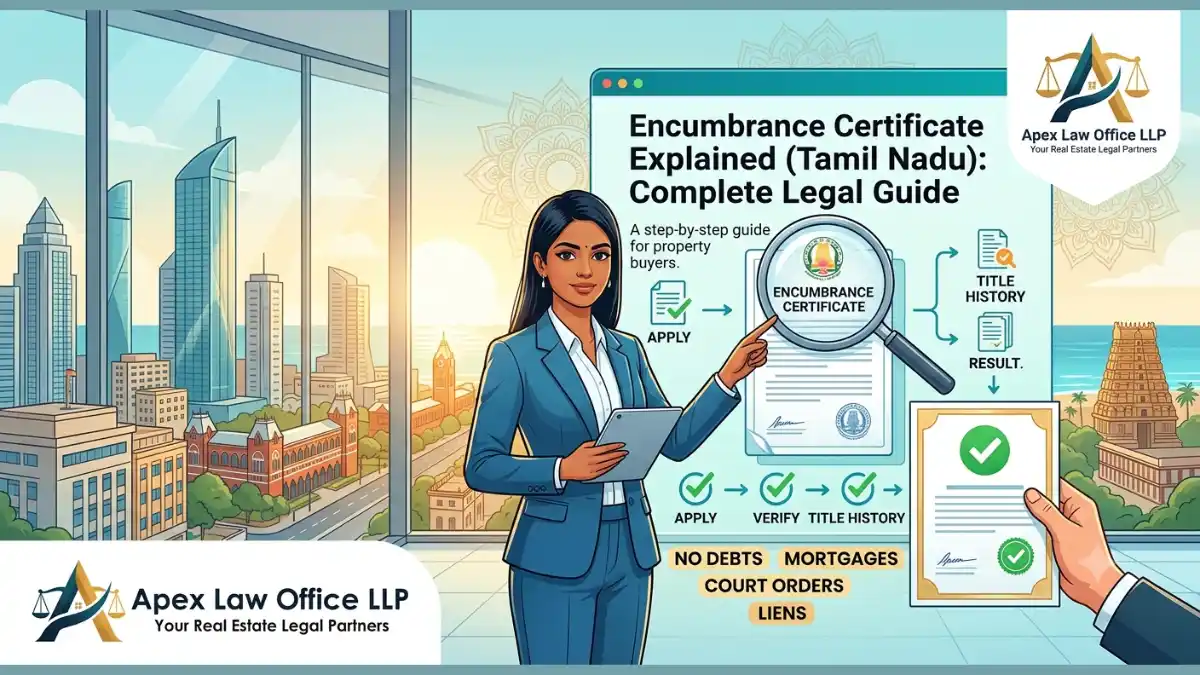
Executive Summary: An Encumbrance Certificate (EC) is an official certificate issued by the registration department that lists the registered transactions and charges affecting a property for the period applied for. For a buyer, it is one of the first documents to examine, because it shows whether the property has been mortgaged or otherwise dealt with by registered documents. This guide explains what an EC shows and does not show, how to obtain it in Tamil Nadu, how to read it, the common red flags, costs and timelines, and NRI-specific points.
Key Takeaway: The EC is an essential first check, but it only shows registered transactions. A “nil” EC does not by itself prove clear title. Always combine it with the title documents, revenue records and court searches.
1. What Is an Encumbrance Certificate?
Definition and Purpose
An EC is a certificate issued by the Sub-Registrar office, based on the registers of registered documents, listing the registered transactions relating to a property over the period requested.
Key details:
- Issued by: The Sub-Registrar office with jurisdiction over the property, through the registration department
- Period: The period you apply for. For a title check, ask for at least 30 years, where the records are available
- Basis: The registers maintained under the Registration Act, 1908
- Purpose: Buyer verification, lender requirement, and title clearance
In Tamil Nadu an EC showing no registered transactions is commonly issued as a “nil encumbrance” certificate, while an EC that lists transactions shows each entry.
Why the EC Is Critical for Buyers
- Title verification: It shows the chain of registered transactions, including earlier sales, mortgages and releases
- Financing requirement: Banks ask for it before lending
- Due diligence: It is an essential first step in verification
- Risk assessment: It can reveal undisclosed registered mortgages and other dealings
- Negotiation: It helps identify what the seller must clear before the sale
2. What Does an EC Reveal?
Entries Typically Shown
An EC lists registered documents such as:
- Sale deeds, gift deeds, settlement deeds, partition and release deeds: showing the chain of ownership
- Registered mortgages: shows the lender, the loan amount and the date. A mortgage is a claim until a release or discharge is registered or otherwise proved
- Registered agreements and powers of attorney: where they relate to the property
- Registered easements and charges: third-party rights recorded by registered documents
- Registered releases or cancellations: showing that an earlier mortgage or transaction has been discharged
What an EC Does Not Show
- Unregistered agreements or transactions
- Equitable mortgages created by deposit of title deeds without a registered document
- Civil suits, injunctions and attachments, unless they result in a registered document
- Criminal cases
- Unpaid property tax, utility dues and other dues that are not registered charges
- Tenant rights
- Boundary encroachments and physical possession
- Whether the person who sold had a valid title in the first place
3. How to Obtain an EC in Tamil Nadu
I. Method 1: Online Application (TNREGINET)
- Register on the registration department’s TNREGINET portal
- Select the EC service and choose the Sub-Registrar office, the period, and the property details (survey number, village, extent or door number)
- Pay the fee online
- Download the EC when issued, and check that it is digitally signed
II. Method 2: Self-Application at the Sub-Registrar Office
- Visit the Sub-Registrar office with jurisdiction over the property
- Submit the application with the property details and the period required
- Pay the prescribed fee
- Collect the EC when it is ready, which can take a few days
III. Method 3: Through an Advocate
- Instruct an advocate, who handles the application and follow-up
- The advocate reviews the EC and explains the entries
The government fee is modest and depends on the period searched. Advocate’s charges are extra. Check the current fee on TNREGINET.
4. Interpreting an EC: Reading the Details
Typical Contents
- Header: Certificate number, date of issue and the office
- Property details: Village or ward, survey number, extent and boundaries as given in the application
- Entries: For each registered document, the serial number, registration date, nature of the document, the parties and the consideration or amount
Example entry:
“Document dated 15 March 2022: Mortgage in favour of ICICI Bank Ltd. Amount: ₹25,00,000.”
“Nil” EC vs. EC With Entries
Nil EC:
- No registered transactions for the period and property searched
- A good sign, but check that the survey number, extent and period are correct, because a wrong description can produce a misleading nil result
EC with entries:
- Registered transactions are listed
- Read each entry. Sales and gifts show the chain of title. Mortgages need a registered release or discharge proof
Interpreting Released Mortgages
A later entry recording a release or reconveyance, or a lender’s discharge certificate, shows that the mortgage has been discharged.
Example: “Mortgage dated 2 June 2019; release deed dated 15 December 2021.” The property is free of that mortgage, but check that the release relates to the same property and the same loan.
5. Red Flags in an EC
Critical Red Flags
1. Active mortgage
- No release is shown or produced
- Action: Require the seller to discharge it at or before registration, and obtain the lender’s no-dues or release document
2. Registered charge or attachment
- A registered charge for a debt or a court order
- Action: Require the seller to clear it, and take advice on whether the sale can proceed
3. Multiple active mortgages
- The property is mortgaged to more than one lender
- Action: Determine the total debt and make sure the sale price is enough to clear it
4. Recent unexplained transaction
- A mortgage, agreement or Power of Attorney registered shortly before the sale
- Action: Ask the seller for an explanation and obtain the document
5. Gap in the chain
- The seller’s own purchase deed or a transfer in the chain does not appear
- Action: Investigate before paying
Caution Flags
- Easement or restriction: It may limit development or use. Understand its terms
- Repeated mortgages and releases: The property has often been used as security. Ask why
- Old entry with no release: It may still be a live claim. Investigate whether it was discharged
6. EC Timeline and Costs
| Scenario | Typical Time | Cost |
|---|---|---|
| Online application (TNREGINET) | A few days | Modest government fee |
| Self-application at office | A few days | Modest government fee |
| Through an advocate | A few days | Government fee plus advocate’s fee |
When to obtain an EC:
- In the first week of due diligence
- Before signing the sale agreement
- A fresh EC close to the registration date, because new registered documents may have been added since the first one
7. Special Considerations for NRI Buyers
Why the EC Matters More for NRIs
- You cannot easily visit the office to check discrepancies
- You rely on your advocate’s report
- Discovering an encumbrance after purchase leads to costly disputes
NRI-Specific Review Process
Step 1: Obtain the EC early. Ask your advocate to obtain it as soon as you shortlist a property, and do not proceed with offers until it is reviewed.
Step 2: Language. The EC may be in Tamil or English. Ask for an English version or a certified translation if needed.
Step 3: Advocate review. Your advocate explains each entry and whether the property can be safely purchased.
Step 4: Lender check. If you are financing the purchase, share the EC with the lender, who will do its own verification.
Step 5: Clearance. If the EC shows a mortgage, the seller must provide a discharge certificate from the lender before registration. Your advocate should verify that it is genuine.
NRI Checklist for the EC
- EC obtained at the start of due diligence, for a long enough period
- Reviewed by your advocate in India
- If mortgaged: the seller gives the lender’s written commitment and timeline for discharge
- Lender confirms the position, if you are financing
- Discharge certificate verified as genuine
- A fresh EC obtained shortly before registration
8. Frequently Asked Questions
FAQ 1: How far back does an EC search go?
Answer: It covers the period you apply for. For a title check, ask for at least 30 years where records are available. Transactions outside the period applied for will not be shown, so check the earlier deeds in the chain as well.
FAQ 2: Is the EC sufficient for due diligence?
Answer: No. It shows only registered transactions. It does not show civil disputes, boundary issues, unregistered dealings, tax arrears or the physical condition of the property. Combine it with the title deeds, patta and chitta, court searches, local body records and a site inspection.
FAQ 3: If the EC is clear, is the property guaranteed safe?
Answer: No. A clear EC means no registered encumbrances for the period searched. The property can still have pending litigation, family disputes, equitable mortgages, encroachments or defects in an earlier link of the chain.
FAQ 4: Can I buy a property if the EC shows an active mortgage?
Answer: It is risky, but it can be managed. The seller can discharge the mortgage before the sale, or the sale proceeds can be used to repay the lender on registration day against a release, or the buyer can take the property subject to the mortgage with the lender’s consent. Most lenders will not finance until the encumbrance is discharged.
FAQ 5: How long is an EC valid?
Answer: An EC records the position up to a date. It has no fixed legal validity, but buyers and lenders usually want one issued recently. Take a fresh EC close to the registration date.
FAQ 6: Can released encumbrances affect title?
Answer: A properly discharged mortgage does not affect current title. Check that the release is registered or properly documented, and that it relates to the right property and loan.
FAQ 7: What if the EC shows a name different from the seller’s?
Answer: Treat it as a red flag. Check whether it is a spelling variation, a name change after marriage or by deed poll, or a different person. Compare the EC, the title deed and the patta.
FAQ 8: Can I obtain an EC for a property I do not own yet?
Answer: Yes. The registers are available for search, so a prospective buyer or advocate can apply for an EC with the property details.
Related Articles
- Property Title Due Diligence in Tamil Nadu: Complete Verification Guide
- Sale Deed Registration in Chennai: Complete Legal Guide
- Property Transactions in Tamil Nadu: Complete Legal Guide
- Patta Transfer for NRI Owners in Tamil Nadu: Complete Guide
- Constitutional Law Attorneys: How to find the Best in Chennai?
- Mutual Consent Divorce cases: How to find the Best Family Court Lawyers?
- Inspector General of Registration – Tamil Nadu
Need Legal Help?
Apex Law Office LLP assists with title verification, agreements, deeds, registration, NRI transactions, inherited property and property disputes in Tamil Nadu.
This article is for general information and is not legal or tax advice.


