
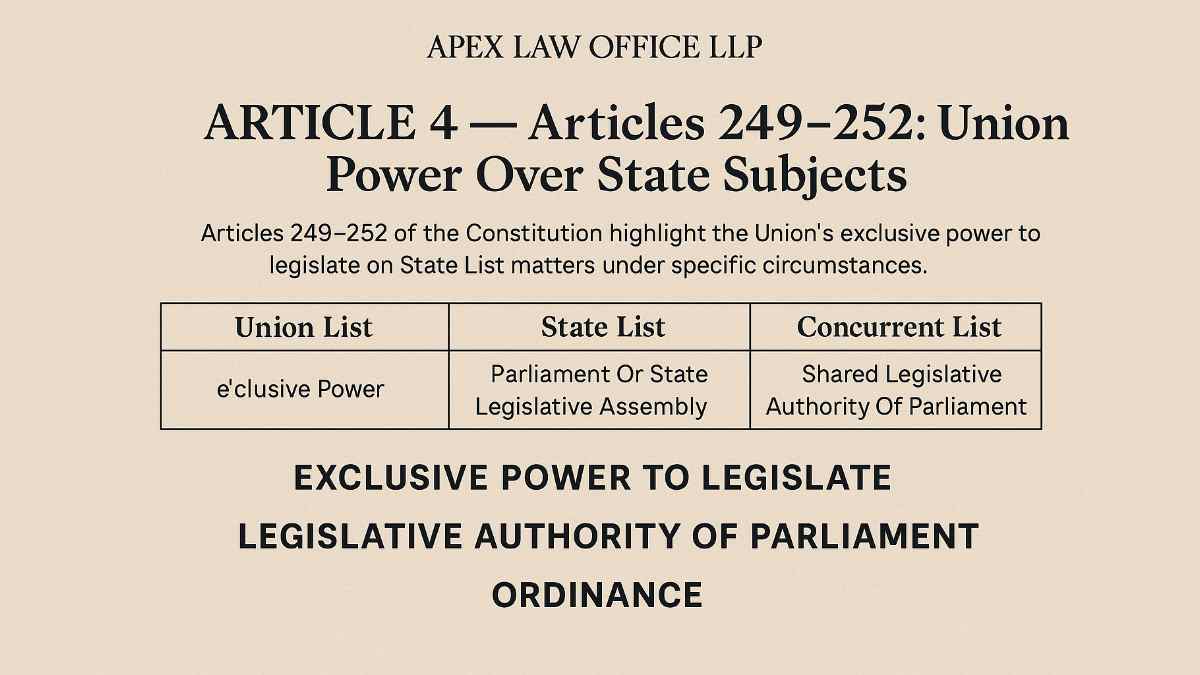
Parliament sometimes needs enhanced authority. So Articles 249–252 of the Constitution explain how Parliament may enter domains in the State List. These provisions guide the Union List and State List relationship. They also clarify when the Legislative Authority Of Parliament expands. The Constitution of India offers this balance since governance demands flexibility. These powers affect major legal disputes involving federal conflict. They also influence remedies that clients seek in court. The State List normally controls local issues. Parliament Or State Legislative Assembly laws differ across fields. Subordinate Legislation grows when central powers expand. Law firms must track each Ordinance issued or attempts to Promulgate Ordinances. These moves impact business regulations. These provisions guide courts while assessing conflicts. They also control the exclusive Power To Legislate in special scenarios. These Legal Provisions help resolve disputes across states. They also stabilise cooperative federalism.
Union Power Under Article 249
When Parliament Steps Into State Territory
Article 249 acts like the “emergency switch” during national interest concerns. Parliament gets power over State List subjects only when the Rajya Sabha approves it. A two-thirds majority becomes mandatory for this step. This power lasts one year. It may also get renewed. Clients often seek clarity during cross-border disputes. This is because jurisdiction shifts quickly.
- National security cases often arise.
- Trade and transport issues also trigger this article.
A quick example helps:
- A business operates in several states.
- It faces different state laws.
- Parliament uses Article 249 to unify the rules.

Legal Issues And Remedies Under Article 249
Cross-state companies face uneven regulations. Lawyers step in to interpret sudden central laws. Corporate clients seek remedies through writs. Administrative disputes grow when authorities misuse centralised power. Contract disputes rise if state approvals get cancelled.
Key remedies include:
- Filing writ petitions under Article 226.
- Challenging jurisdictional overreach.
- Seeking interim protection for ongoing contracts.
- Requesting uniform compliance guidance.
Article 250 And Emergency Powers
Parliament’s Power During Emergencies
Article 250 activates during a National Emergency. Parliament may legislate on all State List matters. This becomes necessary to maintain national stability. Defence and financial systems rely on this article. Businesses face audit requirements. Property matters also face restrictions.
A quick view:
| Emergency | Parliament’s Range | Effect |
|---|---|---|
| National Emergency | Full State List power | Central dominance |
Legal Issues And Remedies Under Article 250
When emergency laws strike, disputes follow. Clients often face restriction orders. Businesses challenge sudden compliance burdens. Individuals contest administrative excess.
Useful remedies include:
- Filing emergency writs for relief.
- Challenging arbitrary restrictions.
- Seeking judicial review for proportionality.
- Requesting protection for essential operations.
Article 251 And Conflict Rules
When Union Law Overrides State Law
Article 251 clarifies that Union laws prevail over State laws. Lawyers rely on this article when advising clients on conflicting rules. Trade, environment, and property cases often involve overlaps. Courts read this article with the Concurrent List.
A compact table helps:
| Law Type | Prevails | Condition |
|---|---|---|
| Union Law | Yes | Conflict exists |
Legal Issues And Remedies Under Article 251
Businesses face penalties when rules clash. Land disputes rise due to overlapping permissions. Regulatory agencies issue contradictory notices.
Remedies available:
- Filing a constitutional challenge.
- Seeking stay of conflicting state action.
- Advising compliance based on prevailing Union law.
Article 252 And Joint State Legislation
States Handing Power To Parliament
Article 252 comes into play when states voluntarily surrender a State List subject to Parliament. This usually happens when states want uniform laws. Urban planning, vehicle regulations, and environmental norms use this model.
Example scenario:
- Two states struggle with pollution norms.
- Both pass resolutions.
- Parliament creates one unified law.
Legal Issues And Remedies Under Article 252
Clients often deal with licensing changes. Companies face new compliance burdens. States may withdraw consent later.
Remedies include:
- Challenging discriminatory enforcement.
- Seeking clarification on legislative competence.
- Filing writs to ensure uniform implementation.
Dispute Resolution And Federal Balance
Courts As Mediators
Courts examine federal conflicts often. Judges use Articles 249–252 to stabilise governance. Federal disputes arise in taxation, environment, police, and education. Law firms assist clients with strategic litigation.
Typical issues include:
- Excess use of central authority.
- Abuse of state power.
- Gaps in joint regulatory frameworks.
Remedies Courts Commonly Grant
Courts issue several solutions:
- Striking unconstitutional laws.
- Issuing clarifications on jurisdiction.
- Directing coordinated action.
- Mandating fair treatment for businesses.
Conclusion: Why These Articles Matter Today
Articles 249–252 of the Constitution shape the Union–State balance. They guide how powers shift during crisis or political need. Modern litigation depends on these rules. Property disputes, regulatory fights, taxation battles, and corporate compliance issues rely on these principles. Clients approach law firms for clarity when both governments claim control. Therefore, lawyers must keep these provisions in sharp focus. These articles protect federalism while enabling national coordination. They also support dispute resolution. Consequently, they remain central to India’s legal ecosystem.
Read More
- How India Is Changing The Way You Think About Law?
- Act Of Parliament: How Laws Are Created, Amended, and Challenged in India
- CONSTITUTIONAL TORT: How to find the Best Legal services in Chennai?
- Ensuring Legal Protection for Vulnerable Family Members Under the National Trust Act
- Legal ownership of a property
FAQs – Articles 249–252: Union Power Over State Subjects
It lets Parliament legislate on State List subjects in national interest with Rajya Sabha approval.
It lasts one year and can be renewed if the Rajya Sabha supports renewal.
It applies only during a National Emergency for full central legislative power.
Yes, Union law prevails when conflicts arise under Article 251.
It allows states to authorise Parliament to enact uniform laws for them.
They may withdraw consent, but Parliament’s law continues until repealed.
Yes, they influence compliance rules and cross-state regulatory obligations.
Yes, writ petitions challenge misuse of central or state power.
Yes, emergency periods expand Parliament’s reach over State List matters.
Yes, courts rely on them during federal disputes and legislative conflicts.


