

Yes — the Digital Personal Data Protection Rules, 2025 are now in force. The Ministry of Electronics and Information Technology (MeitY) notified the DPDP Rules on 13–14 November 2025, operationalising the Digital Personal Data Protection Act, 2023 (DPDP Act). For Indian companies, government departments and any entity that processes the personal data of individuals in India, this converts a long-anticipated statute into an actionable compliance obligation with real deadlines and real penalties.
DPDP Rules 2025: Essential Compliance Action Plan for Indian Companies
Introduction
This article explains, in plain terms, who must comply, what the phased timeline looks like, and the concrete steps a business should take now.
Background: From Act to Rules
The DPDP Act, 2023 received Presidential assent on 11 August 2023, following the Supreme Court’s recognition of privacy as a fundamental right in K.S. Puttaswamy v. Union of India (2017). The Act laid down the framework — data fiduciaries, data principals, consent, and the Data Protection Board of India — but left implementation details, timelines and procedural mechanics to subordinate rules. The DPDP Rules, 2025, notified in November 2025, supply that machinery.
Who Must Comply?
The Act applies to processing of digital personal data within India, and to processing outside India where it relates to offering goods or services to individuals in India. It does not apply to:
- Purely personal or domestic processing by individuals.
- Personal data made publicly available by the data principal or under a legal obligation.
- Certain government processing exempted in the interest of sovereignty, security or public order, as notified.
Every organisation that collects names, phone numbers, email IDs, addresses, financial details, employee records or customer data — from e-commerce platforms to law firms, hospitals, schools and small businesses — falls within scope in some form.
Phased Compliance Timeline
Under Section 1, this section examines the rollout is staggered rather than immediate:
- Immediate/short-term: Provisions relating to the Data Protection Board’s constitution and initial procedural rules take early effect.
- 13 November 2026: The Consent Manager framework under Rule 4 becomes operative, allowing individuals to manage consent across platforms through registered Consent Managers.
- 14 May 2027 (18 months from notification): The bulk of substantive obligations — governance measures, data protection impact assessments, breach notification timelines, data retention limits, and rights of data principals — become fully applicable.
Businesses that treat 2027 as a distant deadline risk being unprepared; the operational changes (contracts, consent flows, internal policies, vendor audits) typically take far longer than the transition window suggests.
Core Obligations for Data Fiduciaries
Generally, every data fiduciary must:
- Obtain free, specific, informed, unconditional and unambiguous consent before processing personal data, through a clear notice in English or any language listed in the Eighth Schedule to the Constitution.
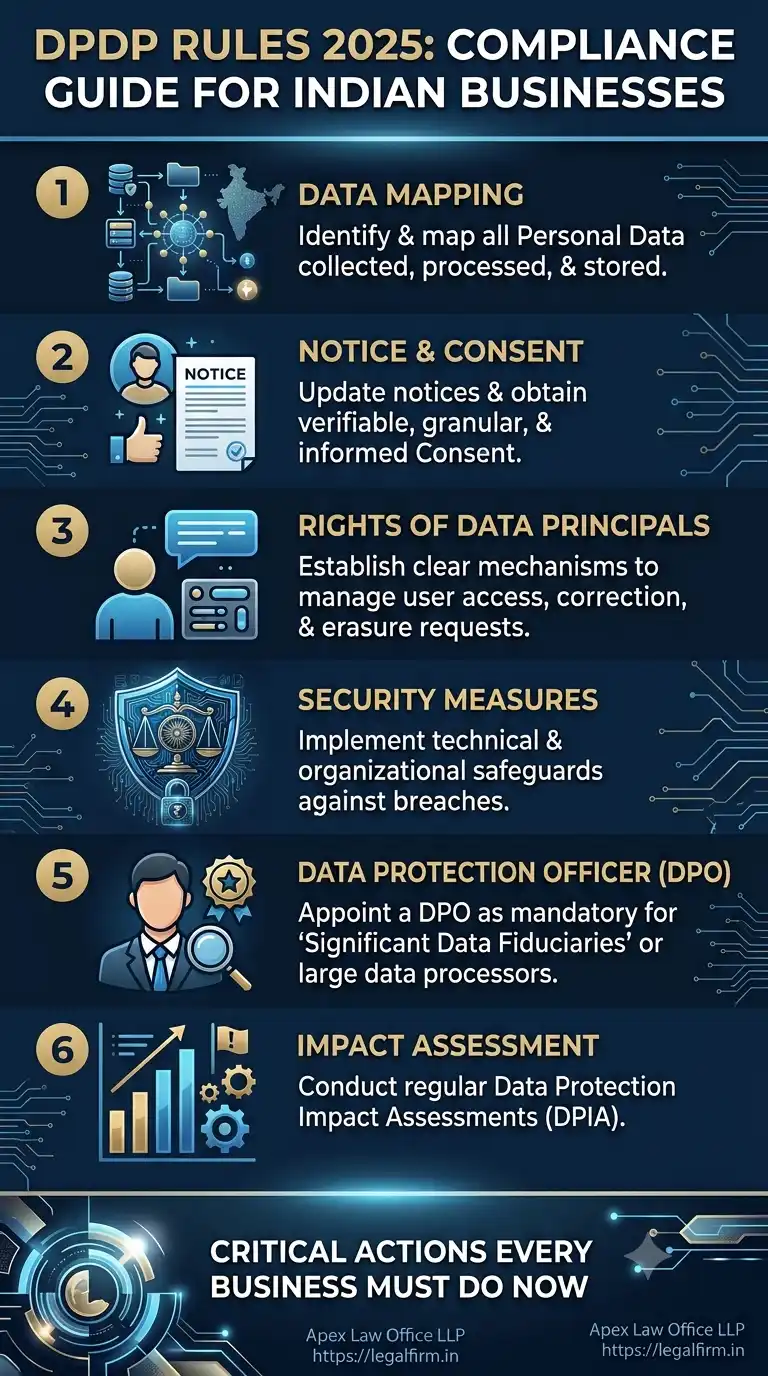
- Implement reasonable security safeguards to prevent personal data breaches.
- Report personal data breaches to the Data Protection Board and affected data principals without undue delay.
- Erase personal data once the purpose is served and retention is no longer necessary, unless retention is required by law.
- Honour data principal rights — access, correction, erasure, grievance redressal, and nomination of a representative in the event of death or incapacity.
Enhanced Obligations for Significant Data Fiduciaries (SDFs)
Entities notified as Significant Data Fiduciaries — typically those processing large volumes of sensitive or high-risk data — face additional duties:
- Appoint a Data Protection Officer (DPO) based in India, reporting to the Board or governing body, who acts as the point of contact for grievances.
- Appoint an Independent Data Auditor to periodically evaluate compliance.
- Conduct a Data Protection Impact Assessment (DPIA) and place a report before the board of directors at least once every twelve months.
- Ensure algorithmic systems used for processing do not compromise data principal rights.
- Comply with any government restrictions on cross-border transfer of specified categories of personal data (Rule 15).
Statutory Framework at a Glance
| Aspect | Provision |
|---|---|
| Parent statute | Digital Personal Data Protection Act, 2023 |
| Implementing rules | DPDP Rules, 2025 (notified 13 Nov 2025) |
| Regulator | Data Protection Board of India |
| Full applicability | 14 May 2027 (phased) |
| Penalty range | Up to ₹250 crore per instance of non-compliance |
Practical Compliance Checklist
- Map all personal data collected, processed and stored (a data inventory).
- Review and rewrite consent notices and privacy policies in plain, unambiguous language.
- Identify whether your organisation is likely to be notified as a Significant Data Fiduciary.
- Draft or update a data breach response plan with defined notification timelines.
- Review vendor and processor contracts for data-processing clauses.
- Build a data retention and deletion schedule.
- Train staff who handle personal data on consent and grievance-handling requirements.
- Track whether the entity needs to register with or through a Consent Manager once that framework is live.
Exceptions and Cautions
- Small businesses and startups are given a facilitative compliance regime, but this is not a blanket exemption — it generally eases the scale of obligations, not their existence.
- The Rules are subject to further clarificatory notifications; entities should track official MeitY communications rather than relying solely on secondary commentary.
- This article reflects the legal position as understood from the November 2025 notification and related government and professional commentary available at the time of writing; readers should verify the current rule text and any subsequent amendments before taking compliance decisions.
What Should You Do Next?
If your organisation processes personal data of Indian residents, begin your compliance groundwork now rather than waiting for the 2027 deadline. A phased internal plan — data mapping, policy revision, contractual updates and staff training — spread over the next few quarters is far more manageable than a last-minute scramble. Legal counsel should review your specific data flows to determine whether Significant Data Fiduciary obligations are likely to apply.
Frequently Asked Questions
Is the DPDP Act, 2023 already in force?
Yes. The Act received assent in August 2023, and the DPDP Rules, 2025, notified in November 2025, operationalise it with a phased timeline running up to May 2027.
Does the DPDP Act apply to small businesses?
Generally, yes, though the Rules provide a facilitative, lighter-touch compliance approach for startups and smaller entities.
What happens if a company fails to report a data breach?
Under the Act, failure to take reasonable security safeguards or to notify a breach can attract penalties from the Data Protection Board, potentially running into hundreds of crores depending on the nature and scale of the breach.
What is a Consent Manager?
A Consent Manager is a registered intermediary through which individuals can give, manage and withdraw consent for data processing across multiple platforms, operative under Rule 4 from 13 November 2026.
Conclusion
The DPDP Rules, 2025 mark the beginning of a genuinely enforceable data protection regime in India. Organisations that start compliance groundwork today — well ahead of the May 2027 deadline — will avoid the operational and reputational risk of scrambling later. This article is for general information only and does not constitute personalised legal advice; specific compliance obligations should be assessed with qualified legal counsel based on your organisation’s actual data processing activities.
Disclaimer
This article is intended for general legal information only and does not constitute legal advice. Laws and rules are subject to amendment; readers should consult a qualified advocate for advice on their specific facts.
Authoritative Sources / References
- Digital Personal Data Protection Act, 2023 — Ministry of Electronics and Information Technology (India Code)
- Digital Personal Data Protection Rules, 2025 — MeitY notification, November 2025
- K.S. Puttaswamy v. Union of India, (2017) 10 SCC 1 — Supreme Court of India


