
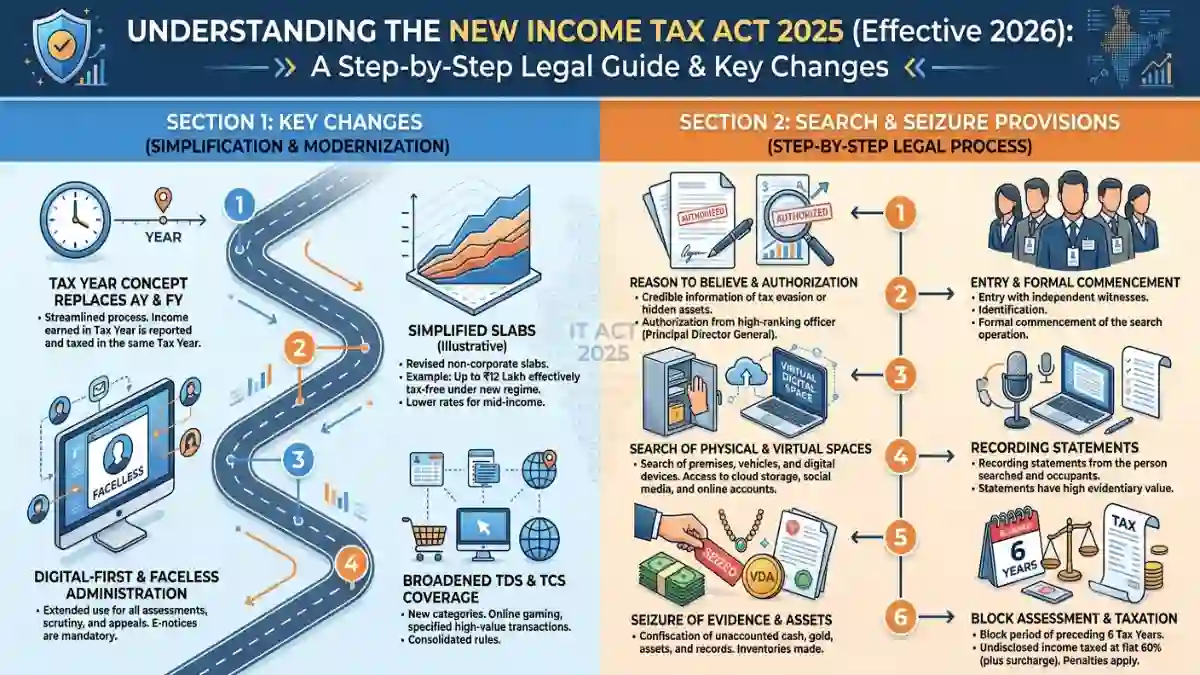
New Income Tax Act 2025 – The Income Tax Act, 2025 takes effect from 1 April 2026 and replaces the Income-tax Act, 1961. The legislation primarily simplifies language, restructures provisions, and reduces interpretational disputes. Moreover, lawmakers aim to improve tax administration and voluntary compliance. Taxpayers, companies, trusts, NGOs, startups, and NRIs must understand the revised framework. Several provisions receive new numbering while preserving substantive principles. Furthermore, digital records now receive clearer statutory recognition. Tax authorities continue exercising assessment, investigation, and enforcement powers under the new law.
New Income Tax Act 2025 (Effective 2026): Key Changes & Search & Seizure Provisions – Apex Law Office LLP
Key focus areas include:
- Tax administration reforms
- Digital compliance measures
- Search and seizure procedures
- Assessment mechanisms
- Appeals and dispute resolution
- Taxpayer rights
| Area | Impact |
|---|---|
| Compliance | Simplified Procedures |
| Administration | Streamlined Structure |
| Litigation | Reduced Ambiguity |
| Investigations | Digital Recognition |
Therefore, taxpayers should review compliance systems before implementation.
Major Changes Affecting Taxpayers
The new statute reorganizes provisions into a simpler structure. Consequently, taxpayers may find interpretation easier than before. Existing compliance obligations generally continue under revised section numbering. Businesses should nevertheless update internal manuals and legal references. Furthermore, professionals must align advisory practices with the new framework. The law introduces clearer drafting and modern terminology. Key changes include:
- Simplified statutory language
- Reorganized chapters
- Digital record recognition
- Reduced legislative complexity
- Updated compliance references
- Improved administrative clarity
Taxpayers should monitor CBDT notifications and implementation guidelines. Legal review helps organizations address transition-related concerns efficiently. Consequently, proactive preparation minimizes compliance risks after commencement.
Tax Compliance and Legal Risk Management
Compliance remains essential despite legislative simplification. Tax authorities continue scrutinizing undisclosed income, false reporting, and evasion practices. Moreover, businesses must maintain accurate books, records, and supporting documents. Digital transactions require stronger documentation and audit readiness. Legal issues commonly involve:
- Assessment disputes
- Penalty proceedings
- Search actions
- Seizure proceedings
- Prosecution risks
- Appellate challenges
Relevant authorities include the Income Tax Department, CBDT, appellate authorities, and tribunals. Taxpayers should seek legal assistance immediately after receiving notices. Consequently, early intervention often reduces exposure to penalties and prolonged litigation.
Search and Seizure Provisions Under the New Act
Search and seizure remains one of the most significant enforcement mechanisms. Section 247 of the Income Tax Act, 2025 governs these powers. Authorities may initiate action when statutory conditions exist. Furthermore, officers require information and recorded reasons before exercising powers. Search actions target undisclosed assets, documents, and relevant information. Digital records receive explicit recognition under the revised framework. Authorities may inspect electronic records and related systems when legally authorized. Key objectives include:
- Detecting concealed income
- Securing evidence
- Preventing document destruction
- Investigating tax evasion
- Preserving revenue interests
- Supporting assessments
Therefore, taxpayers should understand both departmental powers and legal safeguards.
Grounds for Search and Seizure Action
Authorities may conduct searches when statutory requirements exist. Non-production of documents often triggers investigative action. Moreover, officers may act where relevant information appears concealed. The law covers physical and electronic records. Common triggers include:
- Failure to produce records
- Suspected undisclosed assets
- Hidden documents
- Concealed digital information
- Unexplained valuables
- Tax evasion concerns
| Investigative Focus | Examples |
|---|---|
| Documents | Books of Account |
| Assets | Cash and Jewellery |
| Digital Records | Electronic Information |
| Property | Valuable Articles |
Courts generally examine legality when taxpayers challenge search actions. Consequently, proper documentation remains critical during investigations.
Digital Evidence and Electronic Records
Modern investigations increasingly involve electronic information. Therefore, the new law expressly addresses digital records and computer systems. Authorized officers may require access to electronic information relevant to proceedings. Businesses should maintain secure and organized digital records. Furthermore, taxpayers should preserve electronic evidence during investigations. Digital material may include:
- Emails
- Accounting software records
- Cloud documents
- Financial databases
- Investment records
- Business communications
Legal disputes often concern privacy, access scope, and evidentiary integrity. Consequently, professional legal representation becomes important during digital searches. Authorities maintain that these provisions largely continue existing powers while clarifying digital applications.
Rights of Taxpayers During Search Proceedings
Taxpayers possess important procedural protections during investigations. Officers must follow statutory requirements and departmental procedures. Moreover, affected persons may seek legal remedies against unlawful actions. Proper documentation helps preserve taxpayer rights. Important safeguards include:
- Access to records
- Procedural compliance
- Objection mechanisms
- Representation rights
- Judicial review
- Appellate remedies
Individuals should cooperate lawfully while protecting legal interests. Consequently, experienced counsel can evaluate procedural irregularities and challenge unlawful actions where appropriate.
Seizure of Assets and Evidence
Authorities may seize documents, money, jewellery, and valuable articles discovered during searches. Furthermore, officers may record statements on oath during proceedings. Such statements may become relevant evidence in subsequent tax proceedings. Commonly seized materials include:
- Books of account
- Digital devices
- Financial records
- Cash holdings
- Precious metals
- Valuable assets
The department must follow prescribed procedures regarding custody and documentation. Consequently, taxpayers should maintain accurate inventories and preserve evidence supporting ownership claims.
Legal Challenges and Remedies
Taxpayers may challenge unlawful actions through statutory and constitutional remedies. Appellate mechanisms provide review opportunities in appropriate cases. Moreover, courts examine procedural fairness and jurisdictional compliance. Available remedies include:
- Departmental objections
- Appeal proceedings
- Revision petitions
- Writ petitions
- Judicial review
- Constitutional remedies
Relevant forums include appellate authorities, the Income Tax Appellate Tribunal, High Courts, and the Supreme Court. Consequently, strategic legal planning significantly improves dispute resolution outcomes.
Forums, Authorities and Related Legal Proceedings
Several authorities participate in tax enforcement and dispute resolution. Jurisdiction depends upon the nature of proceedings. Furthermore, taxpayers may face parallel civil or criminal consequences in exceptional situations. Relevant institutions include:
| Authority | Function |
|---|---|
| Income Tax Department | Investigation |
| CBDT | Administration |
| ITAT | Appeals |
| High Courts | Judicial Review |
| Supreme Court | Final Appeals |
| Police Stations | Related Criminal Complaints |
The BNS, BNSS, and BSA may become relevant where allegations extend beyond tax issues. Therefore, coordinated legal representation remains valuable in complex matters.
Legal Support for Individuals, Companies, NGOs and NRIs
Different taxpayers face different compliance challenges. Individuals often require assessment and notice-response assistance. Companies commonly address audits, investigations, and litigation. NGOs must maintain exemption-related compliance. NRIs frequently manage cross-border tax concerns. Legal services include:
- Notice responses
- Search representation
- Appeal drafting
- Tribunal advocacy
- Compliance reviews
- Litigation management
Therefore, tailored legal strategies help taxpayers protect rights while meeting statutory obligations.
Why Choose Apex Law Office LLP
Apex Law Office LLP provides comprehensive tax litigation and advisory services. Our lawyers assist during searches, assessments, appeals, and enforcement proceedings. Furthermore, we help clients manage compliance risks proactively. We focus upon protecting taxpayer rights while pursuing practical solutions. Services include:
- Tax investigations
- Search and seizure matters
- Appeals before ITAT
- High Court litigation
- Compliance advisory
- Risk management
Consequently, clients receive effective legal support throughout the tax dispute lifecycle.
Frequently Asked Questions
Does the Income Tax Act 2025 create entirely new search powers?
No. The government states that search provisions largely continue existing powers with clearer drafting and digital recognition.
When does the Income Tax Act 2025 become effective?
The Act takes effect from 1 April 2026 and replaces the Income-tax Act, 1961.
Can tax authorities inspect electronic records?
Yes. Authorized officers may seek access to relevant electronic information during lawful proceedings.
What assets may authorities seize during searches?
Authorities may seize books, documents, cash, jewellery, digital records, and valuable articles under legal procedures.
Which forums hear tax disputes?
Tax disputes commonly proceed before appellate authorities, ITAT, High Courts, and the Supreme Court.
Should taxpayers seek legal help during searches?
Yes. Immediate legal guidance helps protect rights, ensure compliance, and address procedural irregularities effectively.
Read More
- Pension and Retirement Benefits Disputes for Central Government Employees 2026
- Recruitment Rules Violations CBIC: Direct Recruitment Disputes & Legal Solutions 2026
- Challenging Transfer & Posting Orders of Government Employees in CAT 2026
- CCS (CCA) Rules Disciplinary Proceedings 2026: Suspension, Inquiry & Appeal Guide
- CBIC Cadre Restructuring 2026: Impact on Promotions & Legal Rights of Officers
- Income Tax Department (Official Portal)


