
TDS on sale of property by NRI is one of the most misunderstood areas of tax law. When a Non-Resident Indian sells property in India, the buyer must deduct tax at source on the whole sale consideration, and not only on the gain. This can block a large part of the sale money unless a lower deduction certificate is obtained. This guide explains the rule and the steps to reduce the burden.
Tax rules were rewritten from 1 April 2026, when the Income-tax Act, 2025 replaced the 1961 Act. Section numbers and form numbers have changed, and rates should be checked at the time of sale.
TDS on sale of property by NRI: who must deduct and on what amount?
The buyer (resident or non-resident) paying the sale price to a non-resident seller must deduct tax at the rates in force. Under the new Act, the provision on payments to non-residents is in Section 393. The deduction is on the full sale consideration, including the amount paid for the building, and not only on the profit. The rule applies whether the property was bought or inherited.
Rates of tax deduction
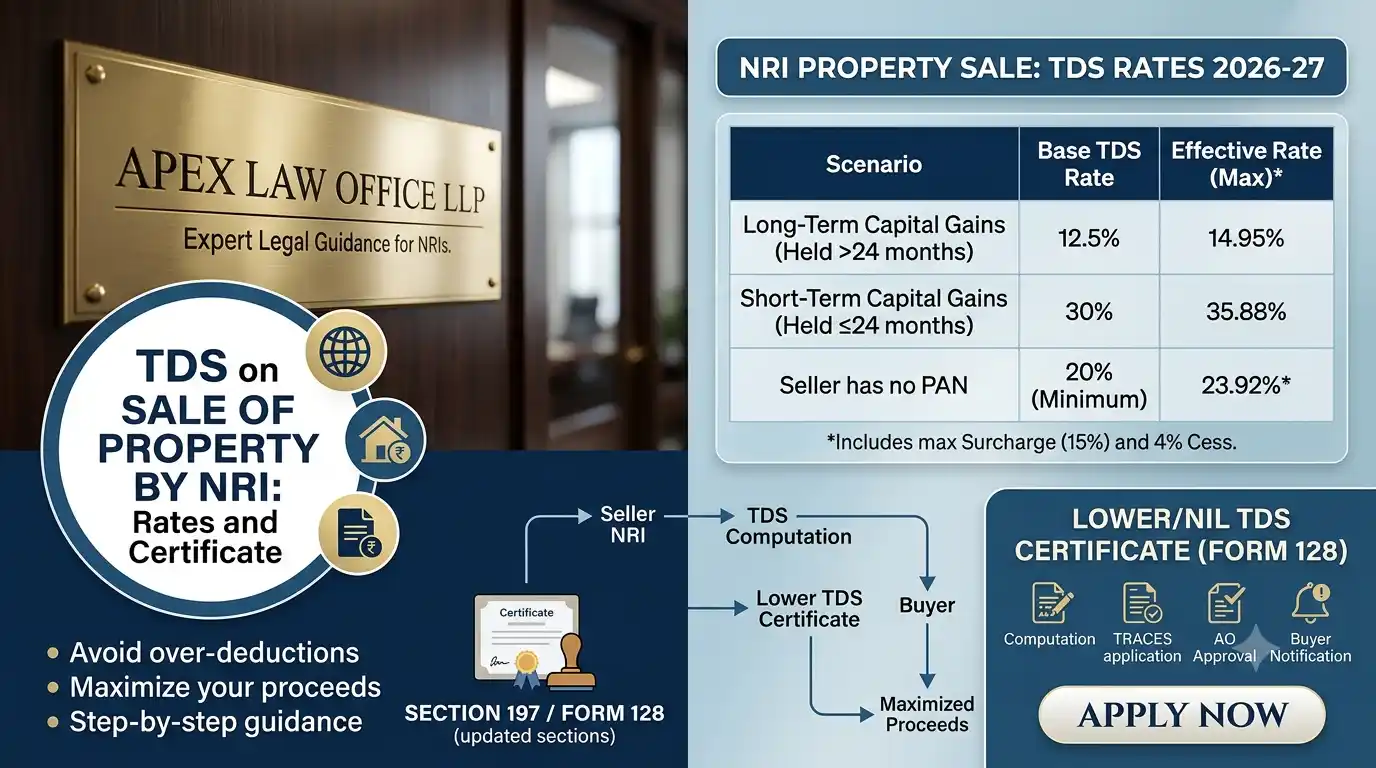
- Long-term capital gain (property held for more than 24 months): 12.5 per cent without indexation, plus surcharge and 4 per cent cess.
- Short-term capital gain (24 months or less): taxed at the applicable rate, which for a non-resident individual is deducted at 30 per cent plus surcharge and cess.
On the long-term rate, the effective TDS rate in practice is about:
- 13 per cent where the sale price is up to Rs 50 lakh (no surcharge).
- 14.3 per cent where the price is above Rs 50 lakh and up to Rs 1 crore (10 per cent surcharge).
- 14.95 per cent where the price is above Rs 1 crore (15 per cent surcharge).
If the NRI does not give a valid PAN, a higher rate of deduction can apply. Surcharge rules can change, so check the current Finance Act.
Why the burden is heavy
Suppose an NRI sells an inherited flat for Rs 1 crore, and his actual capital gain is only Rs 20 lakh. The buyer would have to deduct about Rs 14.3 lakh on the full price, though the real tax on a gain of Rs 20 lakh would be around Rs 2.6 lakh. The balance is refundable only after filing a return, which takes time.
Lower deduction certificate (Form 128)
The solution is a lower or nil deduction certificate from the Assessing Officer under Section 395 of the Income-tax Act, 2025. It replaces the earlier certificate under Section 197.
- The NRI applies in Form 128 with details of the property, the sale price, the cost of acquisition, the capital gain and the tax payable.
- The officer examines the application and issues a certificate specifying the rate, which is binding on the buyer.
- The buyer deducts tax at the certified rate, not at the full rate.
- Processing normally takes several weeks, so apply before the agreement is signed, and mention the timeline in the agreement.
Documents often needed: PAN, passport copy, sale agreement, purchase deed or proof of inheritance, computation of capital gain, reinvestment plan (if any) and bank details.
Exemptions that reduce the gain
A seller can reduce tax by reinvesting in a residential house or in specified bonds within the prescribed time, subject to the conditions. The certificate application can take into account the proposed reinvestment. Seek advice from a chartered accountant before finalising the numbers.
Buyer’s duties
- Deduct tax and deposit it with the government within the due date.
- File the quarterly TDS return and issue the TDS certificate to the seller.
- Obtain the registration needed to deduct (TAN or the alternative the department permits). The rules for buyers have changed in recent years, so confirm the current requirement.
- Do not pay the full amount to the seller before the tax is deducted. An error attracts interest and penalty on the buyer.
Forms for remittance abroad
When the sale money is sent abroad from the NRO account, the bank requires the remittance declaration and, in certain cases, a chartered accountant’s certificate. Under the new Rules these are notified as Form 145 and Form 146, replacing Forms 15CA and 15CB. Repatriation is allowed within the FEMA limit of USD 1 million per financial year from the NRO account, subject to tax payment. For the rules that apply to inherited property, read our guide on NRI inheriting property in India. If a power of attorney handles the sale, see NRI power of attorney for property.
Double taxation relief
Residents of countries having a tax treaty with India can claim relief under the treaty. A tax residency certificate and Form 10F are generally needed. The NRI files an Indian income tax return to claim any refund of excess TDS.
How we can help
Apex Law Office LLP coordinates with chartered accountants to plan NRI property sales, apply for lower deduction certificates and complete registration in Tamil Nadu. The Income-tax Department’s portal, incometax.gov.in, publishes the official forms and notifications.
Frequently Asked Questions
Does the buyer deduct TDS on the full price or only on the gain?
On the full sale price, whether the seller is an NRI who bought or inherited the property. This is why a lower deduction certificate is so useful.
What is the TDS rate on sale of property by an NRI?
For long-term property, the base rate is 12.5 per cent plus surcharge and cess, which works out to about 13 to 14.95 per cent depending on the price. For short-term property, the rate is much higher, about 30 per cent plus surcharge and cess.
How can an NRI reduce the TDS?
By applying to the Assessing Officer for a lower or nil deduction certificate in Form 128 before the sale is completed.
Which section governs the lower certificate now?
Section 395 of the Income-tax Act, 2025, which replaced Section 197 of the old Act. Form 128 replaced Form 13.
How long does the certificate take?
Usually a few weeks, and longer around the end of the financial year. Apply early and build the time into the sale agreement.
Can the sale proceeds be sent abroad?
Yes, from the NRO account up to USD 1 million per financial year, after paying the tax and completing the prescribed forms.
What happens if the buyer does not deduct TDS?
The buyer can be treated as an assessee in default and charged interest and penalty. The seller may face delays in registration or remittance.
Read More
This article is general legal information and not a substitute for advice on your specific matter. Rules, rates and timelines change; verify the current position and consult an advocate before acting.


