
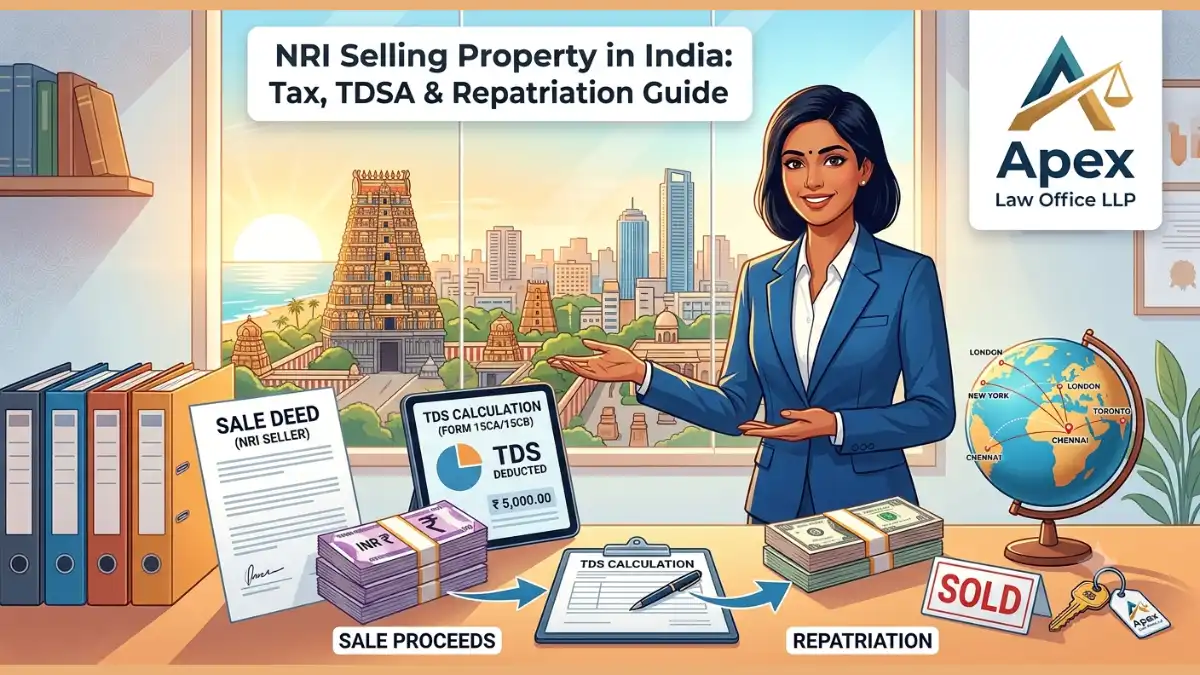
Executive Summary: A Non-Resident Indian (NRI) may sell residential or commercial property in India freely. Agricultural land, plantation property and farm houses can be sold only to a resident Indian citizen. The sale is governed by the Transfer of Property Act, 1882, the Registration Act, 1908, the Income Tax Act and the Foreign Exchange Management Act, 1999 (FEMA). For an NRI the main issues are tax and cash flow. The buyer must deduct tax at source under section 195 on the full sale price (not only on the gain). Unless the NRI obtains a lower-deduction certificate in advance, a large part of the sale price is withheld until the tax return is processed. Repatriation of the proceeds is allowed through an authorised dealer bank, within the limits set under FEMA.
Key Takeaway: Plan the tax before signing the sale agreement. Obtain a lower-deduction certificate (Form 13), fix the TDS clause in the agreement, collect Form 16A, file the Indian tax return, and repatriate through the bank with Forms 15CA and 15CB.
Tax rates and section numbers change with each Finance Act. The Income-tax Act, 2025 has come into force from 1 April 2026 and renumbers many sections. This guide uses the familiar section numbers. Please confirm current rates with a chartered accountant before acting.
NRI Property Sale in India: Tax, TDS, and Repatriation Guide
1. Can NRIs Sell Property in India?
Yes. NRIs and Persons of Indian Origin may sell residential and commercial property without RBI approval. Agricultural land, plantation property and farm houses may be sold only to a resident Indian citizen.
Laws that apply
- Transfer of Property Act, 1882, and Registration Act, 1908 (sale deed and registration)
- Income Tax Act, 1961 (capital gains, section 195 TDS, sections 54, 54EC, 54F, 197)
- FEMA, 1999 and RBI directions (repatriation of sale proceeds)
- Tamil Nadu Stamp Act and registration rules (stamp duty and registration, normally borne by the buyer)
2. Capital Gains on Sale
Capital gain = Sale price − (cost of acquisition + cost of improvement + transfer expenses).
- The sale price is the higher of the agreed price and the guideline value, where the guideline value exceeds the price by more than the permitted tolerance (sections 43CA and 50C).
- Cost of acquisition includes the purchase price, stamp duty and registration paid when buying.
- For inherited property, the cost and holding period of the previous owner are carried over.
3. Short-Term and Long-Term Gains
Holding period: Property held for more than 24 months gives a long-term gain. Property held for 24 months or less gives a short-term gain.
Long-term capital gain (sale on or after 23 July 2024)
- Taxed at 12.5% without indexation, plus applicable surcharge and 4% health and education cess.
- Resident individuals and HUFs who acquired the property before 23 July 2024 may choose between 12.5% without indexation and 20% with indexation. NRIs are generally taxed at 12.5% without indexation. Confirm your own position with a chartered accountant.
Short-term capital gain
- Added to the NRI’s Indian income and taxed at normal slab rates.
Illustration (simplified)
Purchase price (2015):  ₹60 lakh (including stamp duty)
Sale price (2026):      ₹1 crore
Transfer expenses:      ₹2 lakh
Long-term gain:         ₹38 lakh
Tax at 12.5%:           ₹4.75 lakh, plus surcharge (if any) and 4% cess
Ways to reduce or save tax on long-term gains
- Section 54: reinvest the gain in a residential house in India (purchase within 1 year before or 2 years after the sale, or construction within 3 years)
- Section 54EC: invest up to ₹50 lakh of the gain in specified bonds within 6 months
- Section 54F: reinvest the net sale proceeds in a residential house when the property sold is not a residential house
4. TDS on Sale by an NRI (Section 195)
When the seller is an NRI, the buyer must deduct tax at source under section 195 on the entire sale consideration.
- Long-term gain: 12.5% plus surcharge and 4% cess
- Short-term gain: rates applicable to the seller, up to 30%, plus surcharge and cess
- The buyer needs a TAN, deposits the tax and issues Form 16A
- If the seller has no PAN, a higher rate can apply
For comparison, when a resident sells property worth ₹50 lakh or more, the buyer deducts only 1% under section 194-IA. Section 194LA applies to compulsory acquisition of land, not to ordinary sales.
Why the full price matters
On a ₹1 crore sale, default TDS can be roughly ₹14 to ₹15 lakh, although the actual tax on a gain of ₹38 lakh is only about ₹5 lakh. The excess is refunded only after the NRI files the return and it is processed, which can take months.
Lower-deduction certificate (Form 13, section 197)
- The NRI applies to the jurisdictional Assessing Officer before the sale, with the sale agreement, cost proofs and a computation of tax.
- The officer fixes a lower TDS rate or amount, so the buyer withholds only about the real tax liability.
- Build in time: the certificate is often issued within a few weeks, but processing varies.
Form 16A: The TDS certificate issued by the buyer after depositing the tax. Without it the NRI cannot claim credit in the return.
5. Step-by-Step Sale Process
I Stage 1: Pre-sale planning (1–2 months)
- Confirm the title, the encumbrance certificate and patta in your name
- Check the holding period (24-month threshold) and compute the expected gain
- Decide whether to apply for a Form 13 certificate
- Check the availability of a PAN and a bank account (NRO)
II Stage 2: Marketing and offer (1–2 weeks)
- Agree the price with the buyer. Ensure the guideline value is not far above the price
III Stage 3: Sale agreement (1–2 weeks)
The agreement should state that the seller is an NRI, record the TDS under section 195 on the full price (or the Form 13 rate), fix who obtains the TAN and files the challan, set a timeline for Form 16A, and specify the NRO account for payment.
IV Stage 4: Payment and TDS (payment day)
- The buyer pays the balance after deducting TDS, deposits it with the government and issues Form 16A
- Payment should be through banking channels only
V Stage 5: Sale deed and registration (1–2 weeks)
- The NRI signs in person before the Sub-Registrar, or through a registered Power of Attorney executed abroad, notarised and apostilled (or attested at the Indian embassy for non-Hague countries), and registered or adjudicated in India
- Stamp duty and registration fees are usually borne by the buyer
VI Stage 6: Collect Form 16A and compute tax
VII Stage 7: File the Indian tax return
- File by 31 July of the following year (the due date may differ for audit cases). Report the sale, claim TDS credit and pay any balance tax. Claim the refund of excess TDS here
VIII Stage 8: Repatriate funds (see below)
6. Repatriation and FEMA
Sale proceeds are normally credited to the NRO account. They can be moved abroad through an authorised dealer bank, subject to the following.
- Limit: Up to USD 1 million per financial year can be remitted from NRO account balances, including sale proceeds of immovable property. The limit is not unlimited.
- Residential property bought from foreign funds: The sale proceeds of up to two residential properties can be repatriated, within the conditions set by RBI for the original investment. Gains are remitted within the USD 1 million limit.
- Documents: Form 15CA (self-declaration) and Form 15CB (chartered accountant’s certificate), the sale deed, proof of tax paid or TDS, Form 16A, the income tax return acknowledgement where needed, and a bank undertaking.
- LRS: The Liberalised Remittance Scheme is for resident individuals. NRIs use the facility above, not LRS.
- Maintain evidence of the source of funds used to buy the property.
Banks apply their own internal checks. Start the process early, and consult the authorised dealer bank and a chartered accountant.
7. Compliance and Documentation
Documents to keep
- Sale deed, purchase deed and encumbrance certificate
- Patta and chitta extracts, property tax receipts
- PAN, passport, overseas address proof, visa or residency proof
- Form 13 certificate (if obtained), Form 16A, challan details
- Computation of capital gains and supporting invoices for improvements
Income tax return
- An NRI with Indian capital gains must file a return, even if TDS has been deducted
- Disclose foreign income only as the law requires, and check the tax treaty with the country of residence for relief from double taxation
Power of Attorney for overseas sellers
- Limit the powers to this sale and fix the minimum price and the account for payment
- Execute before a notary and apostille the document (or consular attestation where the country is outside the Hague Convention)
- Register the document in India as needed
8. Common Mistakes NRI Sellers Make
- No PAN: Leads to a higher TDS rate and delays
- Not applying for Form 13: Tax is withheld on the whole price and the refund takes long
- Not collecting Form 16A: TDS credit cannot be claimed
- Not filing the return: The refund and the repatriation documents are affected
- Selling just before 24 months: A short-term gain taxed at slab rates replaces the 12.5% long-term rate
- Ignoring exemptions: Missing sections 54, 54EC or 54F
- Cash dealings or an undervalued deed: Creates tax and legal exposure
- Assuming unlimited repatriation: The USD 1 million per financial year limit applies
9. Timeline and Cost Breakdown
| Stage | Indicative time |
|---|---|
| Pre-sale planning and Form 13 | 3–8 weeks |
| Agreement and buyer due diligence | 3–6 weeks |
| Sale deed and registration | 1–2 weeks |
| Form 16A | 2–6 weeks after payment |
| Tax return and refund | Several months |
| Repatriation process | 2–6 weeks, after documents are complete |
Typical seller costs: Advocate fees, chartered accountant fees for gains computation and Form 15CB, brokerage if any, bank charges and any Power of Attorney expenses. Stamp duty and registration fees (about 7% and 4% for a sale deed in Tamil Nadu, as per current notifications, to be confirmed on TNREGINET) are normally paid by the buyer.
10. Frequently Asked Questions
FAQ 1: Can I avoid capital gains tax by selling to a relative?
Answer: No. A sale to a relative is taxed in the same way, and if the price is below the guideline value the tax authorities may treat the guideline value as the price (sections 43CA and 50C). A genuine gift is a different transaction with its own stamp duty and tax consequences.
FAQ 2: What if I sell at a loss?
Answer: No capital gains tax arises on a loss, but you should still file the return. A long-term capital loss can be carried forward for eight years and set off against long-term gains only. The buyer’s TDS may still have to be handled through Form 13 or a refund.
FAQ 3: If I reinvest the sale proceeds, can I save tax?
Answer: Yes, if you meet the conditions under sections 54, 54EC or 54F. These reliefs have time limits and caps, so plan before the sale.
FAQ 4: What happens if the buyer does not deduct TDS?
Answer: The buyer becomes liable to pay the tax along with interest and penalty. The NRI’s own tax liability on the gain remains, and the return must still report it.
FAQ 5: Can I get a TDS refund?
Answer: Yes. File the return and claim credit for the TDS in Form 16A. Any excess is refunded after processing, which can take several months. A Form 13 certificate reduces the excess at source.
FAQ 6: If I sell within 24 months, can I claim the long-term rate?
Answer: No. Property held for 24 months or less gives a short-term gain, taxed at slab rates.
FAQ 7: Will I be taxed in my country of residence on the same gain?
Answer: Possibly. Many countries tax worldwide income. India’s double taxation avoidance agreements provide credit or exemption in many cases. Take advice in both countries.
FAQ 8: How long do I have to repatriate the proceeds?
Answer: There is no fixed deadline, but the USD 1 million per financial year limit and the bank’s documentation requirements make early planning important. Proceeds can stay in the NRO account until you are ready to remit.
Related Articles
- NRI Buying Property in Chennai: Complete Legal Guide
- Property Transactions in Tamil Nadu: Complete Legal Guide
- Inherited Property Sale in Tamil Nadu: Complete Legal Guide
- Patta Transfer for NRI Owners in Tamil Nadu: Complete Guide
- Foreign Exchange Management Act, 1999
- Sale Deed Registration in Chennai: Complete Legal Guide
- PMLA: How to Choose the Best Money Laundering Case Lawyers?
Need Legal Help?
Apex Law Office LLP assists NRIs with title verification, sale agreements, Power of Attorney, registration support in Tamil Nadu, and coordination with tax advisers for TDS and repatriation.
This article is for general information and is not legal or tax advice.


