
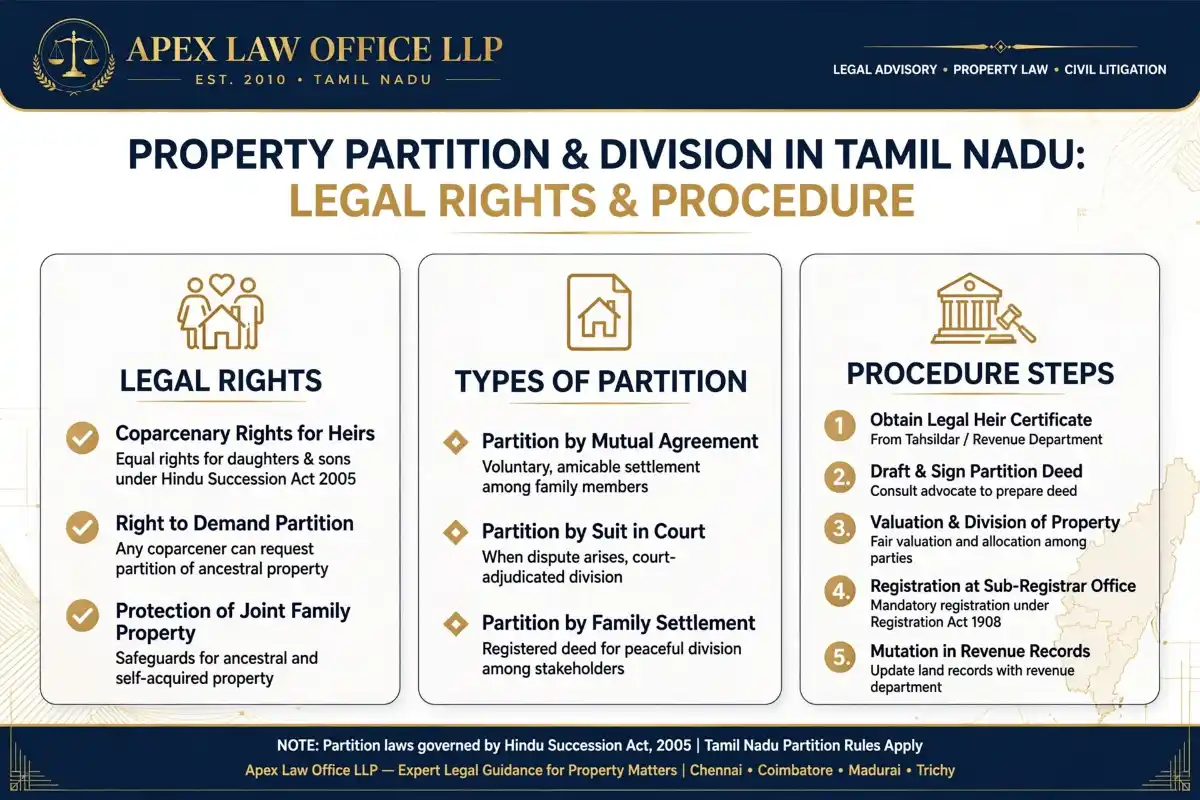
Executive Summary: Through property partition, co-owners divide jointly owned property into separate holdings so that each owner holds a defined portion exclusively. Unfortunately, frequent disagreements among co-owners often delay this essential legal process for years. Furthermore, a badly drafted or unregistered partition leaves serious title defects that make the property difficult to sell and directly invite future litigation. To prevent these costly issues, this guide thoroughly covers the specific rights and liabilities of every co-owner involved. Additionally, it explains both voluntary division methods and formal legal partition procedures conducted through the court system. The guide also details the essential contents of a valid partition deed while addressing common disputes and the partition process among legal heirs after a death. Ultimately, by following these practical insights, property owners can easily avoid critical legal mistakes during the division process.
Key Takeaway: A voluntary partition by a properly drafted and registered deed is quick and cheap. A court partition is slow and costly. Obtain advocate guidance before you divide, record the division precisely, and register the deed.
How to Partition and Divide Property in Tamil Nadu: Legal Rights & Step-by-Step Procedure
1. What Is Property Partition?
Definition and Legal Basis
Partition converts joint ownership of the whole property into separate ownership of defined parts. After partition, each former co-owner is the exclusive owner of an allotted portion.
Legal framework:
- Transfer of Property Act, 1882: Provisions on co-owners and joint transferees
- Code of Civil Procedure, 1908: Suits for partition and final decrees (Order XX, Rule 18)
- Partition Act, 1893: Special rules for partition of dwelling houses and sale in lieu of partition
- Hindu Succession Act, 1956: Rights of Hindu heirs and coparceners, including the equal rights of daughters after the 2005 amendment
- Indian Succession Act, 1925 and personal laws: Succession for others
- Registration Act, 1908: A written partition affecting immovable property must be registered
Why Partition Occurs
- Agreement: Co-owners agree to divide the property
- Dispute: One co-owner insists on separation and the others refuse
- Succession: Several heirs inherit and decide to divide
- Family division: Joint family property is divided among members
Partition Compared With Other Methods
| Method | Result | Comment |
|---|---|---|
| Partition | Each owner gets a separate defined share | Hard to reverse once registered |
| Sale and division of proceeds | Property is sold and the price divided | Simple when the property cannot be divided physically |
| Release of share | One co-owner gives up their share to the others | Done by a registered release deed |
2. Co-ownership Rights and Liabilities
Rights of Co-owners
Right to possession: Each co-owner is entitled to enjoy the whole property in common with the others, without excluding them.
Right to partition: A co-owner can ask for partition, and if the others refuse, can sue for it. This right can be restricted by agreement for a reasonable period.
Right to income: Rent and other income belong to the co-owners in proportion to their shares. One co-owner cannot keep all of it.
Right to deal with their own share: A co-owner can transfer or mortgage their own undivided share, but not the whole property without the others.
Liabilities of Co-owners
Taxes and charges: Co-owners share the property tax and other charges on the property in proportion to their shares, and a local body can recover arrears from the property.
Creditors: A creditor of one co-owner can proceed against that co-owner’s share, not against the shares of the others. Practical difficulties still arise because the share is undivided.
Mortgages: If the whole property is mortgaged by all, the lender can enforce against the property as a whole.
Red Flags in Co-ownership
- One owner secretly mortgages or sells their share, bringing in a stranger as co-owner
- One owner rents out the property and keeps all the rent
- One owner refuses partition for years, leaving the property difficult to sell
- The property has multiple mortgages
- One owner has judgment debts
3. Partition Procedure in Tamil Nadu
Voluntary Partition (Agreed Division)
All co-owners must agree on the shares, the physical division and any money adjustment if parts are of unequal value.
Step 1: Agreement. The co-owners meet and agree the shares and the broad division, with a sketch of the divided parts.
Step 2: Verification of title. Obtain the EC, patta and chitta, and check mortgages, litigation and approvals.
Step 3: Valuation. Obtain a valuation, or agree a value, for each part, to see whether any equalising payment is needed.
Step 4: Division plan. A surveyor or architect prepares a plan showing each part with boundaries and dimensions. Where land is divided, check the layout and approval requirements for subdivision, and apply for sub-division of the patta after the partition.
Step 5: Draft the partition deed. The advocate drafts the deed with the parties, the original property, the divided parts, shares, any payment, liabilities and easements.
Step 6: Stamp duty and registration fee. Concessional rates apply to partitions among specified family members (reported at about 1% stamp duty and 1% registration fee, subject to caps), and full rates apply otherwise. Confirm the current notification before execution.
Step 7: Registration. All parties present the deed at the Sub-Registrar office with identity proofs and witnesses. Present it within 4 months of execution.
Step 8: Revenue records. Apply for patta sub-division and transfer for each part, and separate property tax assessments.
Timeline: About 2 to 6 weeks for a voluntary partition, depending on surveys and sub-division approvals.
Court Partition (Forced Partition)
If a co-owner refuses to cooperate, any co-owner can file a partition suit in the civil court that has jurisdiction.
- Plaint: The suit is filed with all co-owners as defendants, and court fee is paid on the plaint
- Summons and written statements: All parties are served and give their positions
- Trial and preliminary decree: The court decides each party’s share
- Commissioner: The court may appoint an advocate commissioner to divide the property by metes and bounds, or recommend a sale if division is not possible
- Final decree: The court passes the final decree, which is stamped and, where required, registered
- Revenue records: The parties apply for patta and tax changes
Timeline: Often several years, depending on the court, the number of parties and any appeals.
Cost: Court fee, advocate’s fees, commissioner and surveyor’s fees and valuation charges. These vary widely with the value and complexity of the case.
4. Partition Deed: Critical Elements
Essential Components
1. Parties: All co-owners, with full names, addresses and IDs. If a co-owner has died, their legal heirs must join.
2. Original property description: Full address, survey number, extent, boundaries, and any mortgages or charges.
3. Divided parts: Each part described by location, boundaries, area and the co-owner to whom it is allotted.
Example:
“The property known as Plot No. 45/2, West Mogappair, Chennai, bearing survey number 2384, measuring 5,000 sq ft, is partitioned as follows: Part A (2,700 sq ft) is allotted to Mr. Rajesh Kumar, bounded on the north by [description], south by [description], east by [description] and west by [description]. Part B (2,300 sq ft) is allotted to Ms. Priya Sharma, bounded on the north by [description], south by [description], east by [description] and west by [description].”
4. Shares: Each owner’s entitlement, for example “Owner 1: 54% (2,700 sq ft); Owner 2: 46% (2,300 sq ft)”.
5. Equalising payment: If the parts are of unequal value, the deed states the amount payable and by whom.
6. Debts and liabilities: Who assumes which loan, and how taxes and dues are shared. A lender’s consent may be needed to split a mortgage.
7. Easements: Passage, drainage and water rights between the parts should be recorded.
8. Possession: A statement that each party has been given possession of their part.
9. Stamp duty and registration: As applicable to the deed and the relationship between the parties.
5. Common Partition Disputes
Dispute 1: Unequal Division
One part is more valuable because of its frontage or location. The disadvantaged owner may challenge the partition. Solution: A valuer’s report and an equalising payment, recorded in the deed.
Dispute 2: Mortgage Not Divided
The property is mortgaged and the deed is silent. The lender can still pursue the whole property. Solution: Specify who assumes which part of the debt, and obtain the lender’s written consent.
Dispute 3: Hidden Encumbrance
No EC or title check was done before the partition, and a charge is discovered later. Solution: Do the title checks first, and record known easements and charges in the deed.
Dispute 4: Minor Co-owner
A minor cannot validly execute a deed. A guardian dealing with a minor’s immovable property generally needs the court’s permission (for example under the Hindu Minority and Guardianship Act, section 8, for Hindu minors). Solution: Obtain the court’s permission, and ensure the minor’s share is protected.
Dispute 5: Missing or Untraceable Co-owner
One co-owner cannot be found. Solution: Make genuine efforts, including newspaper notice, and seek the court’s directions. A voluntary partition cannot bind a co-owner who has not joined.
6. Special Points for Hindu Joint Families
- Daughters are coparceners by birth and have the same rights as sons in joint family property after the 2005 amendment to the Hindu Succession Act, as confirmed by the Supreme Court
- Ancestral and self-acquired property are treated differently, so the history of the property should be traced
- A partition in a joint family can be by agreement or by suit, but the shares must be correctly calculated
- A will or a gift by one member may affect only that member’s share
7. Partition After Death (Succession)
No Will
- Identify the legal heirs under the law that applies to the deceased
- Obtain a legal heir certificate from the Tahsildar
- The heirs agree the division and sign a registered partition or family arrangement deed
- Apply for patta transfer and tax changes
With a Will
- The executor obtains probate where required (generally mandatory for wills made in the City of Chennai)
- The property is distributed as the will provides
- Heirs or beneficiaries sign a deed where a division of jointly inherited property is needed
See our article on selling inherited property for more on heirship documents.
8. Common Mistakes and How to Avoid Them
Mistake 1: Dealing With a Minor’s Share Without Court Permission
The deed can be set aside later. Fix: Obtain the court’s permission.
Mistake 2: No Title Search
A mortgage or dispute is discovered after the partition. Fix: Obtain the EC, patta and chitta, and a court search first.
Mistake 3: Debts Not Allocated
The deed is silent on a loan, so the creditor can pursue any owner. Fix: Allocate the debt and obtain the lender’s consent.
Mistake 4: No Compensation for Unequal Division
One part is more valuable and nothing is paid. Fix: Valuation and an equalising payment.
Mistake 5: Vague Boundaries
Disputes arise after the partition. Fix: A surveyor’s plan, physical demarcation and a precise description in the deed.
Mistake 6: Possession Not Handed Over
One owner continues to occupy the entire property. Fix: Record and effect possession of each part immediately.
Mistake 7: Deed Not Registered
An unregistered partition deed affecting immovable property is not effective as such and cannot be relied on for title. Fix: Register it, and present it within 4 months of execution.
9. Frequently Asked Questions
FAQ 1: Can one co-owner force partition?
Answer: Yes, by filing a partition suit. The court will determine the shares and divide the property, or order a sale where division is not feasible. This can take years, so a voluntary partition is preferable.
FAQ 2: What if one co-owner refuses to sign the deed?
Answer: A voluntary deed needs all co-owners. If one refuses, the remedy is a partition suit, and the final decree then operates against that co-owner.
FAQ 3: Does the partition deed cancel the original title deed?
Answer: No. The earlier title deeds remain the evidence of the chain of title. The partition deed records the division, and each owner should obtain certified copies of the earlier deeds that relate to their share.
FAQ 4: Can a partition be reversed after registration?
Answer: Only by consent of all parties through another registered deed, or by a court on grounds such as fraud, coercion or mistake. This is difficult and slow.
FAQ 5: What happens to a mortgage during partition?
Answer: The mortgage must be cleared or allocated, and the lender’s consent is generally needed. Until then the lender can enforce against the whole mortgaged property.
FAQ 6: Is a partition deed different from a court partition?
Answer: The result is similar, but the route differs. A voluntary deed is made by agreement and registered. A court partition is made by decree after a suit.
FAQ 7: Can property tax be divided after partition?
Answer: Yes. After the partition and sub-division of the patta, apply to the local body for separate assessments, so each owner pays tax on their own part.
FAQ 8: How long does registration take?
Answer: If the documents are in order, registration can be completed within a day or a few days at the Sub-Registrar office. The surveys, valuations and sub-division approvals take most of the time.
Related Articles
- Inherited Property Sale in Tamil Nadu: Complete Legal Guide
- Release Deed for Property in Tamil Nadu: Complete Guide
- Gift Deed vs Settlement Deed: Comprehensive Comparison
- Property Disputes & Resolution in Tamil Nadu: Complete Legal Guide
Need Legal Help?
Apex Law Office LLP assists with title verification, agreements, deeds, registration, NRI transactions, inherited property and property disputes in Tamil Nadu.
This article is for general information and is not legal or tax advice.


