
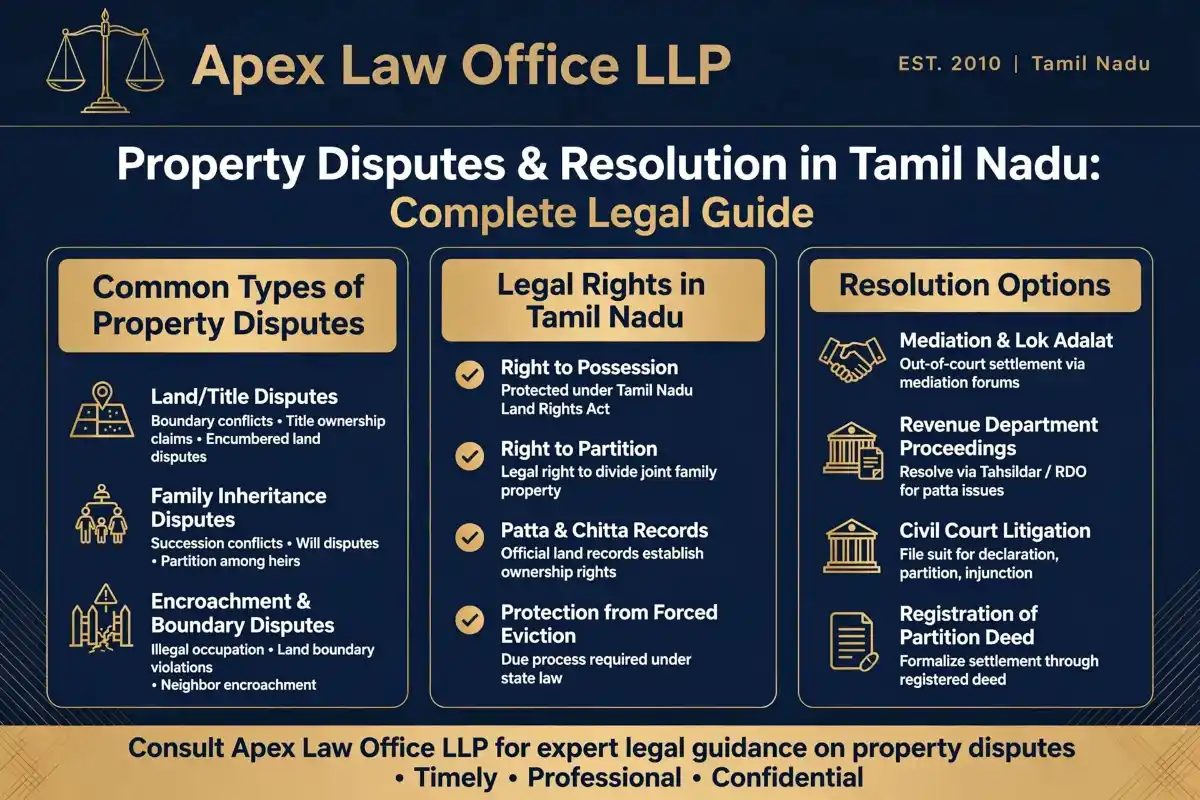
Executive Summary: Property disputes are among the most common civil cases in India. They affect buyers, sellers, co-owners, tenants, neighbours and heirs. They range from boundary encroachments and title defects to possession conflicts and inheritance claims. Left alone, they can run for years in court. This guide covers the common types of property disputes, how to prevent them, how to resolve them before and during litigation, the main court remedies, and special points for NRI owners.
Key Takeaway: Prevention is far cheaper than cure. Check title before you pay, put everything in writing, act early when a dispute begins, and try negotiation or mediation before litigation, while keeping an eye on limitation periods.
1. Common Types of Property Disputes
Dispute Type 1: Boundary and Encroachment
Nature: A neighbour’s structure or fence extends onto your land, or you are alleged to have encroached.
Common scenarios:
- A wall or fence is built beyond the boundary
- A building overhangs or blocks access
- Disagreement over the boundary line after a sub-division or partition
Legal basis: Property and possession rights, the Specific Relief Act, 1963 (injunction, possession), and the Indian Easements Act, 1882.
Typical outcomes: Boundary survey, removal of encroachment, injunction, compensation.
Dispute Type 2: Title Defects
Nature: A buyer finds a defect in the title after purchase.
Common scenarios:
- A hidden mortgage or attachment
- An undisclosed co-owner or heir claims a share
- The seller’s title was forged or the seller was not the true owner
- The chain of title is broken
Legal basis: Transfer of Property Act, 1882 (seller’s duty of disclosure and the buyer’s remedies), the Indian Contract Act, 1872 (fraud and misrepresentation), and suits for declaration of title.
Typical outcomes: Declaration of title, cancellation of the sale, refund and damages.
Dispute Type 3: Possession
Nature: The buyer has paid but cannot get possession, or someone is in unlawful occupation.
Common scenarios:
- The seller delays possession
- A tenant refuses to vacate
- Relatives or strangers occupy the property
Legal basis: The Specific Relief Act, 1963 (suits for possession, including a summary suit within six months of dispossession without due process), and the Transfer of Property Act.
Typical outcomes: Decree for possession, damages for wrongful occupation, injunction.
Dispute Type 4: Inheritance and Succession
Nature: Heirs disagree on who inherits what.
Common scenarios:
- Widow and children disagree on shares
- A daughter claims equal rights in ancestral property
- A will is challenged for forgery, undue influence or lack of capacity
Legal basis: Hindu Succession Act, 1956 (including the 2005 amendment), the Indian Succession Act, 1925, personal laws, and probate law.
Typical outcomes: A decree declaring each heir’s share, probate or refusal of probate, and partition.
Dispute Type 5: Tenancy
Nature: Landlord and tenant disagree on rent, eviction, deposit or repairs.
Legal basis: The Tamil Nadu Regulation of Rights and Responsibilities of Landlords and Tenants Act, 2017, which provides for rental agreements, rent authorities and eviction grounds, and the Transfer of Property Act.
Typical outcomes: Eviction order, arrears of rent, deposit refund, damages.
Dispute Type 6: Partition
Nature: Co-owners cannot agree on dividing property.
Legal basis: The Code of Civil Procedure, 1908 (partition suits), the Partition Act, 1893 and the relevant succession law.
Typical outcomes: Preliminary and final decrees, division by metes and bounds or sale and division of proceeds.
Dispute Type 7: Agreement and Contract
Nature: Disputes over the sale agreement, payment, possession date or default.
Legal basis: Indian Contract Act, 1872 and the Specific Relief Act, 1963 (specific performance, which a court can order, in general, if the buyer shows readiness and willingness to perform).
Typical outcomes: Specific performance, refund of advance, damages, cancellation.
2. Prevention Strategies
I – Prevention 1: Thorough Due Diligence
- Obtain an EC for a long enough period
- Verify the patta, chitta and revenue records
- Search court records for pending cases
- Verify the chain of title and the parent document
- Inspect the property and neighbouring boundaries
See our guide on property title due diligence in Tamil Nadu.
II – Prevention 2: Clear Written Agreements
- Exact price and payment schedule
- A specific possession and completion date
- Conditions precedent so the buyer can exit if title is defective
- Balanced default clauses
- A jurisdiction and dispute resolution clause
III – Prevention 3: Involve an Advocate Early
- Avoid oral arrangements and unregistered documents
- Have the agreement reviewed before signing
- Have the deed checked before registration
IV – Prevention 4: Boundary Demarcation
- Commission a survey if the description is unclear
- Build boundary walls or fencing
- Get written acknowledgment of boundaries from neighbours where possible
Prevention 5: Registration and Documentation
- Register all important documents
- Keep original deeds safely, with copies elsewhere
- Keep correspondence and receipts
- Pay through banking channels only
3. Pre-Litigation Resolution Methods
Method 1: Negotiation
Identify the issue, communicate in writing, state your position, listen to the other side, look for common ground, and record any settlement in writing. It is the fastest and cheapest method, but it fails if the other party is unreasonable.
Method 2: Mediation
A neutral mediator helps the parties reach a settlement. Court-annexed mediation is available through the Tamil Nadu Mediation and Conciliation Centre, and the Mediation Act, 2023 provides a framework for mediation and the enforceability of mediated settlement agreements. The mediator cannot impose a decision.
Method 3: Legal Notice
An advocate sends a formal notice setting out the dispute, the demand and a deadline. It creates a record, and a notice is mandatory before suing the government and in some other cases. It can prompt settlement, but it can also harden positions.
Method 4: Lok Adalat
Lok Adalats under the Legal Services Authorities Act, 1987 help settle disputes by consent, including pending cases. An award is treated as a decree and is final, and no court fee is payable.
Method 5: Arbitration
If the agreement contains an arbitration clause, or the parties agree later, an arbitrator can decide the dispute, and the award is enforceable under the Arbitration and Conciliation Act, 1996. Certain disputes, such as those about title in rem or matters reserved for courts, may not be suitable for arbitration, so take advice.
4. Litigation: When Negotiation Fails
When to File Suit
- The other party refuses to settle
- Your legal right is clear and supported by documents
- The value or the rights at stake justify the cost
- Urgent protection is needed, such as an injunction
- A limitation period is about to expire
Time Limits (Limitation)
Limitation periods are strict. As examples, a suit for specific performance of a contract must generally be filed within three years from the date fixed for performance (or from when the plaintiff has notice of refusal), and a suit for possession based on title is generally within twelve years of the defendant’s adverse possession. Take advice at once, because delay can extinguish a remedy.
Types of Property Suits
- Suit for specific performance: The buyer asks the court to compel the seller to complete the sale on the agreed terms.
- Suit for possession: Recovery of possession from a tenant, trespasser or occupant.
- Suit for declaration of title: The court declares who owns the property, and removes a cloud on title.
- Suit for partition: Division of jointly owned property.
- Suit for damages or refund: Compensation for breach, fraud or misrepresentation.
- Suit for injunction: The court restrains a party from an act, such as building on or selling the disputed land. Temporary injunctions are decided early in the case.
During a pending suit, any transfer of the disputed property is subject to the outcome of the suit (the doctrine of lis pendens, section 52, Transfer of Property Act).
Litigation Process (Simplified)
Phase 1: Filing. The advocate prepares the plaint and files it in the court that has territorial and pecuniary jurisdiction (the Munsif Court, Subordinate Court, District Court, or the original side of the Madras High Court or the City Civil Court for Chennai city matters, depending on value). Court fee is payable on the plaint.
Phase 2: Service. Summons are served, and the defendant files a written statement, generally within 30 days, which can be extended in limited circumstances.
Phase 3: Issues and evidence. The court frames issues. Parties file documents and examine witnesses.
Phase 4: Trial. Arguments are heard.
Phase 5: Judgment and decree. The court passes judgment. For a partition suit there are preliminary and final decrees.
Phase 6: Appeal and execution. A party can appeal to the higher court. The winning party executes the decree.
How Long Does It Take?
Property suits can take several years, depending on the court, the complexity, the number of parties and any appeals. Negotiation or mediation can resolve the same dispute in weeks or months, which is why they are worth trying first.
5. Special Considerations for NRI Owners
NRI-Specific Challenges
- Distance: Appearances are usually through an advocate, and video-conference hearings may be possible with permission
- Time zones: Communication is slower
- Documents: Original deeds and witnesses are in India
- Authority: You may need to execute a Power of Attorney, properly authenticated and apostilled, in favour of a person who can sign documents and give evidence on your behalf
- Cost: A long case increases costs
NRI Dispute Prevention Checklist
- Instruct a local advocate before the purchase, not after a dispute
- Have documents verified by a video call with your advocate
- Get a clear EC and court searches before paying
- Execute a proper written agreement
- Execute a limited POA, properly authenticated, where someone must act for you
- Keep communications in writing (email, not only messaging apps)
- Keep certified copies in India and originals safe
- Check in regularly with your advocate
NRI Litigation Strategy
- Act early: Try negotiation or mediation within weeks
- Instruct in writing: Email your instructions to create a record
- Limit appearances: Appear only when necessary, and ask whether remote appearance is allowed
- Plan realistically: A contested property suit takes years
- Keep settlement open: A settlement can be recorded even during the suit
6. Frequently Asked Questions
FAQ 1: Should I file a suit immediately or try negotiation first?
Answer: Try negotiation or mediation first where the facts allow, but keep a close eye on limitation, and file promptly if you need urgent protection such as an injunction.
FAQ 2: How much does property litigation cost?
Answer: It depends on the value, the court, the complexity and the duration. Costs include advocate’s fees, court fee on the plaint, surveyors and valuers, and expert or commissioner fees. Ask your advocate for an estimate based on your facts.
FAQ 3: How long does a property suit take?
Answer: Often several years, and longer if there are appeals. Title and succession suits tend to take longer than simple recovery matters.
FAQ 4: Can I represent myself without an advocate?
Answer: A party may appear in person, but property law and procedure are technical, and mistakes can be costly. Engage a qualified advocate.
FAQ 5: What if I lose the suit?
Answer: You can consider an appeal within the limitation period, or a settlement with the other party. Discuss the prospects and costs with your advocate before appealing.
FAQ 6: Can property be sold during a pending dispute?
Answer: It can be, unless the court has restrained the transfer, but the buyer takes it subject to the outcome of the suit (lis pendens). In practice, buyers and banks avoid such property, so it is hard to sell.
FAQ 7: What is the quickest way to resolve a dispute?
Answer: Usually negotiation, then mediation or a Lok Adalat. Litigation is for cases where these fail or where urgent court orders are needed.
FAQ 8: Should I keep paying property tax and loan instalments during a dispute?
Answer: Yes. Obligations such as property tax and loan repayments continue regardless of the dispute, and non-payment creates additional liability.
Related Articles
- Property Partition & Division in Tamil Nadu: Legal Rights & Procedure
- Property Title Due Diligence in Tamil Nadu: Complete Verification Guide
- Property Transactions in Tamil Nadu: Complete Legal Guide
- Inherited Property Sale in Tamil Nadu: Complete Legal Guide
Need Legal Help?
Apex Law Office LLP assists with title verification, agreements, deeds, registration, NRI transactions, inherited property and property disputes in Tamil Nadu.
This article is for general information and is not legal or tax advice.


